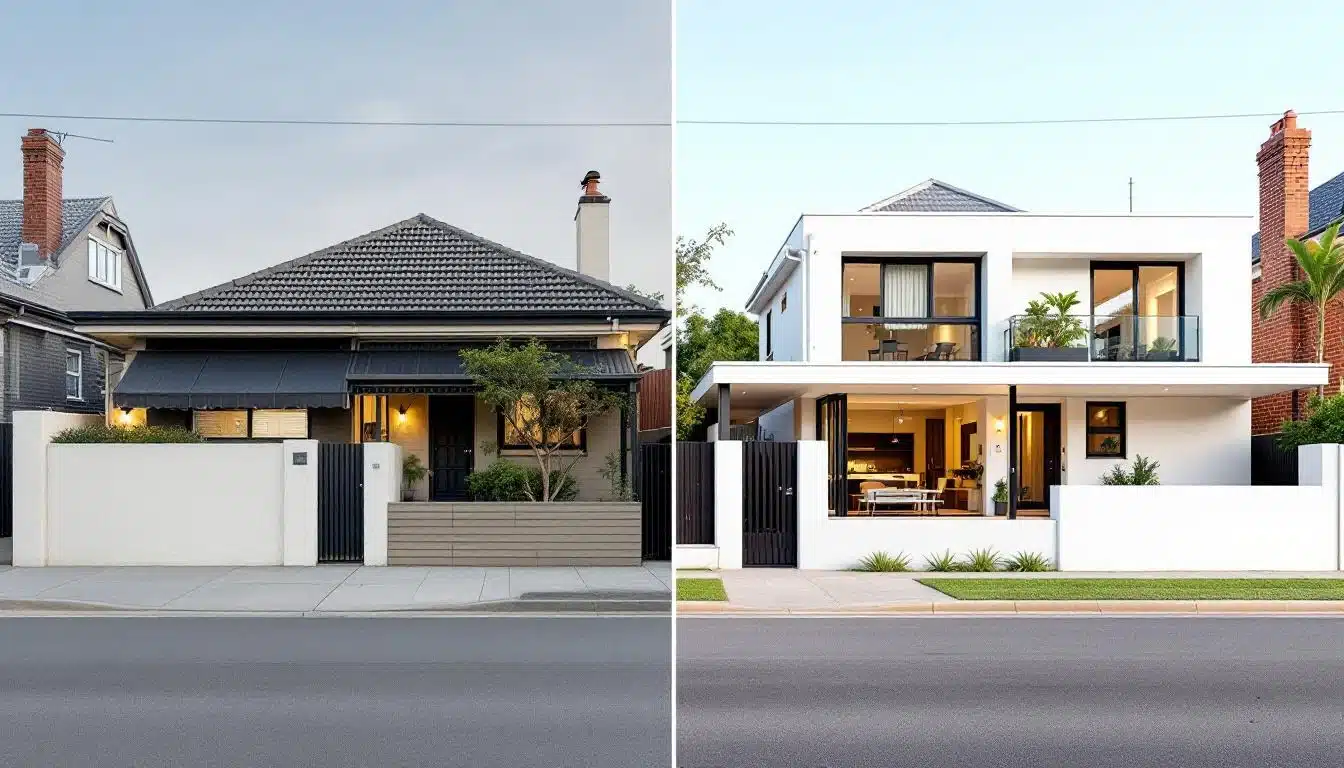
Melbourne Extension Case Studies: Real Homes, Real Transformations
Melbourne homeowners often wonder whether an extension is worth the investment. We at Cameron Construction have guided hundreds of families through this process, and the results speak for themselves.
These Melbourne extension case studies show real homes transformed by thoughtful design and expert planning. From heritage properties in Toorak to challenging sloping blocks across the suburbs, you’ll see how the right approach turns constraints into opportunities.
Extending a Heritage Home in Toorak
Toorak properties present a specific challenge that separates serious builders from the rest. Many of these homes date back to the 1920s and 1930s, sitting on blocks that feel generous by today’s standards but constrain modern living expectations. The Heritage Council of Victoria maintains strict guidelines for any visible alterations, meaning your extension cannot simply sit at the back of the property and call itself done. The honest truth is this: fighting the heritage requirements wastes time and money. Working with them saves both.
Understanding Heritage Overlay Requirements
The Heritage Council does not exist to prevent extensions. It exists to prevent bad ones. A poorly designed extension that ignores the original home’s proportions, materials, and setbacks creates visual discord that actually damages property value. The Council’s assessment focuses on whether new work respects the existing building’s character.
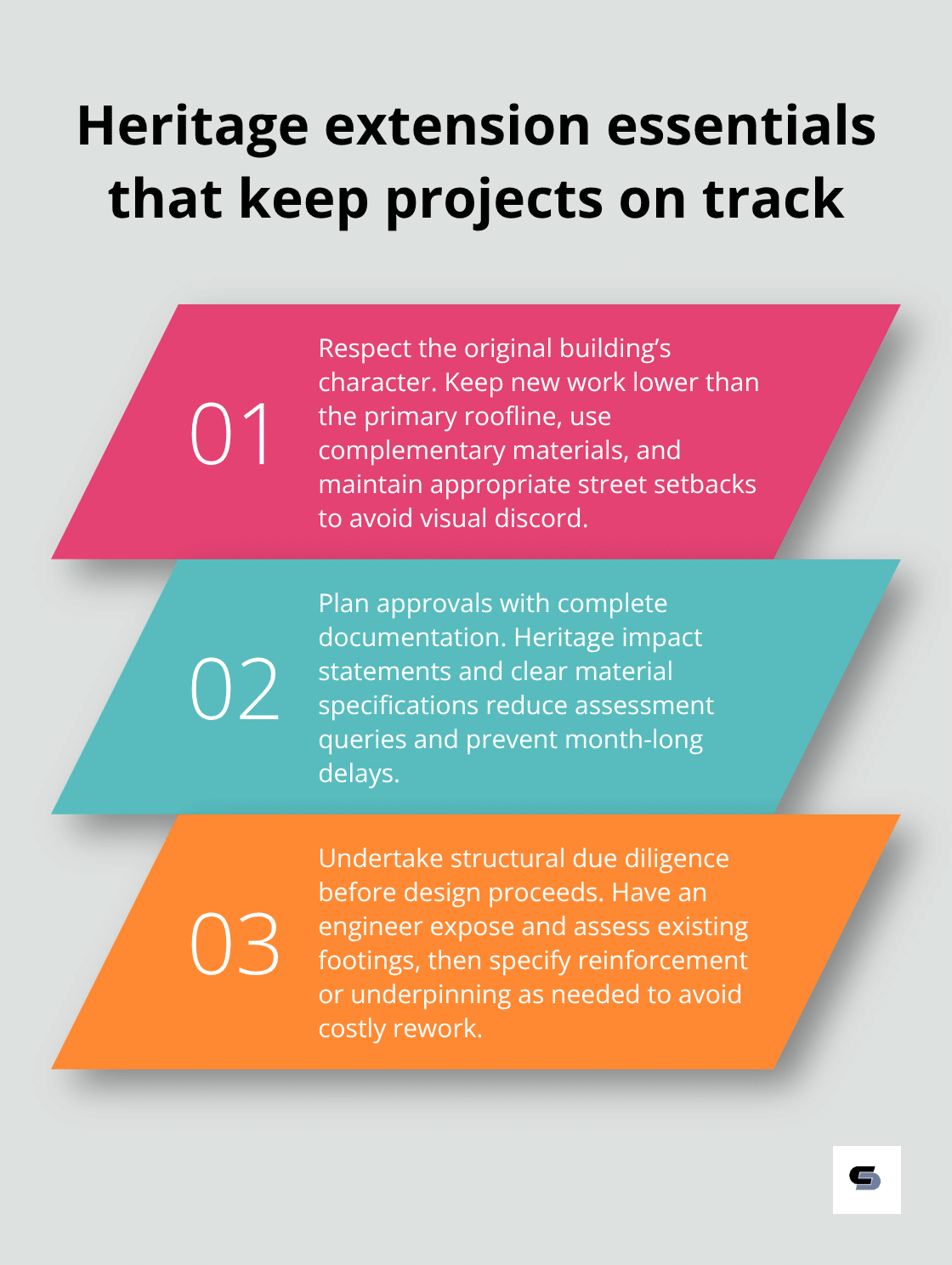
This means your extension should sit lower than the original roofline, use complementary materials rather than matching ones, and maintain adequate setback from the street frontage.
Most Toorak properties fall under the Stonnington Planning Scheme’s Heritage Overlay, which requires a planning permit for certain building activities. This process takes 4 to 8 weeks on average, but submitting incomplete documentation stretches it to 12 weeks or beyond. Engaging your designer early to produce heritage impact statements and material specifications prevents rejection letters that waste months.
Structural Reality for Older Properties
Homes built in the 1920s and 1930s rarely have the foundation capacity that modern building codes demand for a second storey addition. You cannot simply add weight and assume the footings will hold. A structural engineer must expose the existing foundations, determine their depth and bearing capacity, and specify reinforcement or underpinning before design proceeds. This investigation typically costs between $1,500 and $3,500, but skipping it creates liability and rework costs that multiply rapidly.
Brick veneer construction, common in Toorak’s postwar properties, requires careful detailing where new work meets old. The existing walls often contain no cavity barriers or damp-proof membranes by modern standards. Your builder must specify additional waterproofing at junctions to prevent moisture migration into the original structure.
Meeting Modern Performance Standards
Meeting the National Construction Code for thermal performance while preserving heritage character demands careful insulation placement. You should select insulation placement carefully-inside the new work rather than against the heritage fabric. This approach maintains the building’s external appearance while delivering energy efficiency that reduces running costs significantly. Successfully designing heritage extensions demonstrates that heritage constraints and modern performance standards coexist when planned properly.
These heritage considerations shape how your extension takes form. Ground floor additions and double storey extensions across Melbourne’s other suburbs face different constraints entirely, and understanding those differences determines whether your project stays on budget and on schedule.
Ground Floor and Double Storey Additions Across Melbourne Suburbs
Matching Your Block to the Right Extension Type
Ground floor and double storey additions across Melbourne’s suburbs succeed or fail based on how well you match your block’s constraints to the right extension type. A narrow Camberwell block cannot accommodate the same solution as a generous Balwyn property, and pretending it can costs thousands in redesign fees. Most blocks in inner Melbourne measure 400 to 600 square metres, with many sitting narrower than 15 metres across the frontage. Ground floor additions work best here because they preserve your existing roof structure and avoid the complex setback negotiations that double storey work demands. A single-level extension at the rear or side typically requires fewer planning permit conditions and costs 30 to 40 percent less than a two-storey addition on the same footprint. The trade-off is straightforward: you gain less total space.
Double storey extensions make sense when your block depth exceeds 25 metres and your council’s setback requirements allow building to within 4 to 6 metres of the rear boundary. These additions deliver substantially more usable space, but they demand more complex structural work and longer approval timelines.
Understanding Council-Specific Planning Requirements
Councils across Melbourne vary significantly in their requirements. Stonnington and Boroondara enforce stricter setbacks than Moreland or Footscray, which means your extension’s footprint on a Hawthorn block will be smaller than an identical property in Brunswick. Check your specific council’s planning scheme before your designer produces detailed plans. Spending two hours reading your council’s requirements online saves 10 weeks of permit delays later.
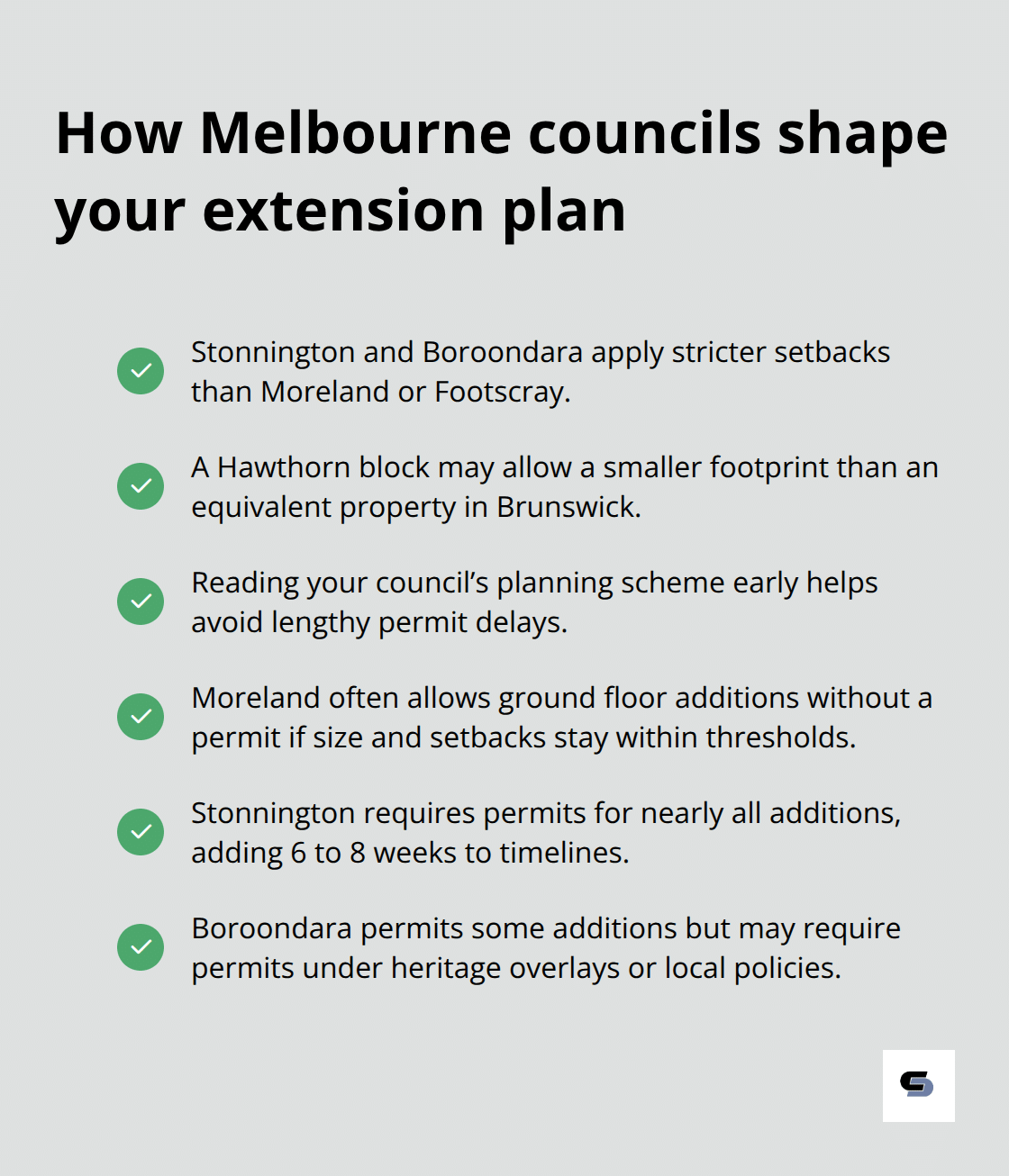
Moreland processes most ground floor additions without a permit if the addition stays within certain size thresholds and maintains setbacks from boundaries. Stonnington requires a permit for nearly all additions, which extends timelines by 6 to 8 weeks. Boroondara sits between these extremes, permitting some additions but requiring permits for others based on heritage overlays or specific local policies. Understanding your council’s specific thresholds before committing to a design prevents expensive redesigns when your builder discovers mid-project that a permit was required after all.
Defining Scope to Control Costs
Cost-effective extensions for growing families depend on honest scope definition before construction starts. Too many homeowners begin extensions without deciding whether they want a third bedroom, a second bathroom, or both. This ambiguity leads to value engineering mid-project, where your builder suggests cheaper materials or smaller spaces to hit an arbitrary budget. The better approach involves understanding your genuine needs, then designing the extension to deliver exactly those needs without padding.
A 30-square-metre ground floor addition in Thornbury costs between $120,000 and $160,000 depending on finishes and site conditions, according to recent builds in that area. A 40-square-metre double storey extension in the same suburb typically ranges from $180,000 to $240,000. These figures assume standard construction on level ground with straightforward access. Your actual costs depend on foundation conditions, existing utilities that require relocation, and whether your existing home needs structural bracing before new work attaches.
Planning Approval Timelines Across Different Areas
Planning approval outcomes vary dramatically between councils. Stonnington requires a permit for nearly all additions, which extends timelines by 6 to 8 weeks compared to councils with more permissive thresholds. Moreland and Footscray process applications faster because their planning schemes allow more additions without formal permits (though you still need to comply with building codes). Boroondara’s approach depends heavily on whether your property sits within a heritage overlay or a specific local policy area. Understanding these differences before you commit to a design prevents costly delays and redesigns.
The complexity of your site also affects approval timelines. A straightforward ground floor addition on a level block with no heritage overlay moves through council assessment in 4 to 6 weeks. A double storey extension on a sloping block with heritage considerations can stretch to 12 weeks or longer. These timelines matter because every week of delay costs money in professional fees and pushes your construction start date further into the future.
Sloping blocks introduce additional engineering complexity that transforms both your timeline and your budget in ways that ground floor and double storey additions on level sites do not address.
Sloping Block Extensions and Complex Site Challenges
Sloping blocks transform extension projects from straightforward additions into engineering challenges that demand respect and expertise. Melbourne’s topography means many inner suburbs sit on blocks that slope 1 metre or more across their length, and outer suburbs like Belgrave and Sherbrooke slope far more dramatically. A 2-metre fall across a 25-metre block depth requires retaining structures, adjusted foundations, and careful drainage planning that level-block extensions simply do not require.
Site Investigation and Structural Assessment
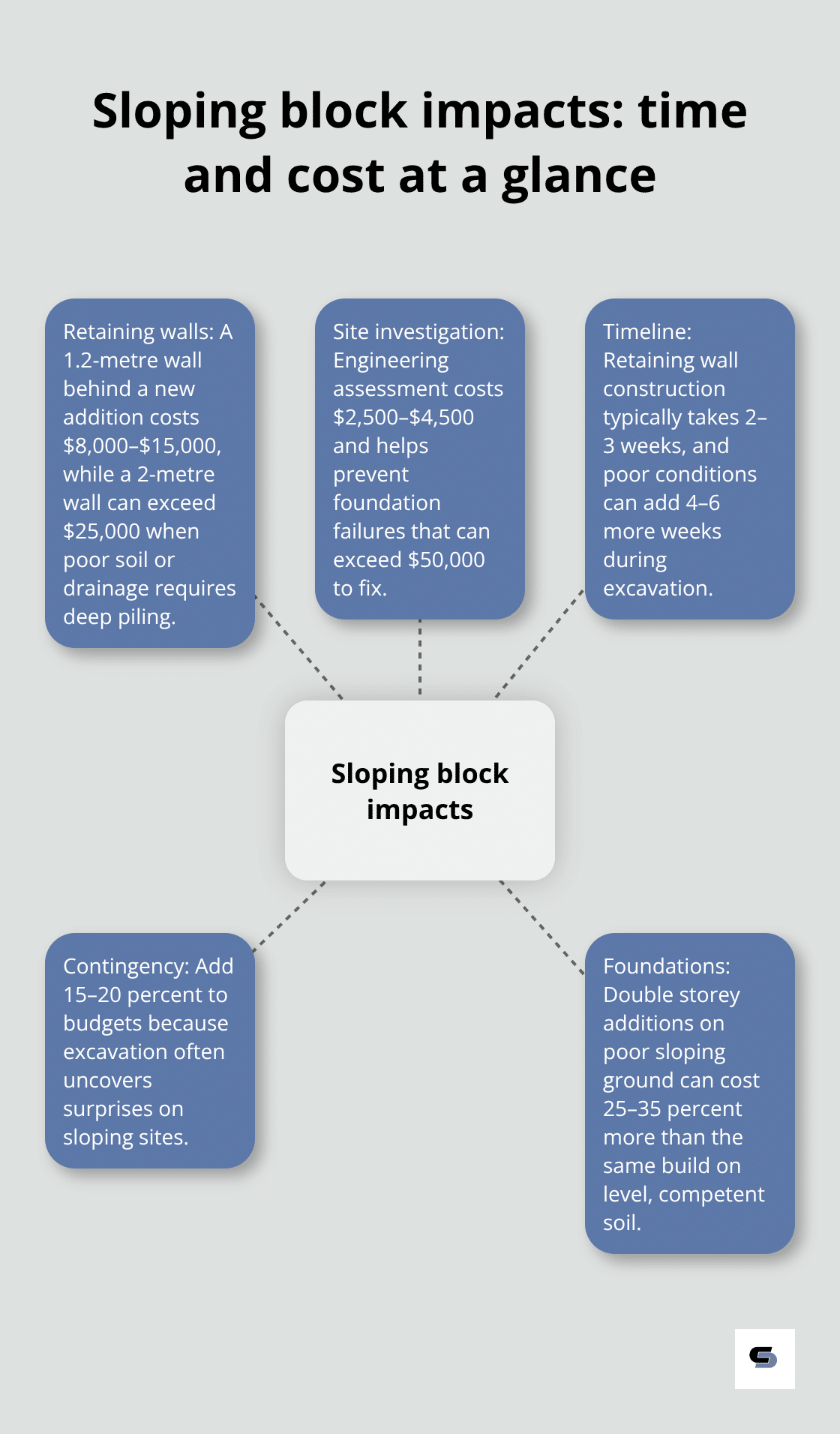
The structural engineer’s role shifts from verification to design leadership on sloping sites. You cannot proceed with concept drawings until the engineer assesses the site’s bearing capacity, soil classification, and drainage characteristics. This assessment costs $2,500 to $4,500 but prevents foundation failures that cost $50,000 or more to repair. Discovering poor bearing capacity after construction starts destroys budgets and timelines, which is why thorough investigation must happen before any design progresses beyond preliminary sketches.
Retaining Walls and Drainage Solutions
Retaining walls become necessary when your extension footprint requires cutting into a slope. A 1.2-metre-high retaining wall behind a new ground floor addition costs between $8,000 and $15,000 depending on materials and soil conditions. A 2-metre wall can exceed $25,000 if poor drainage or unstable soil requires deep piling or complex drainage systems. The engineer must specify whether the wall requires piled foundations, what drainage measures are necessary, and whether the existing slope above the wall needs stabilisation.
Concrete block construction works for straightforward applications, but poor soil conditions or significant heights often demand reinforced concrete or soldier-pile solutions that cost substantially more. Your building surveyor must verify that the retaining wall design complies with the Building Code of Australia’s requirements for lateral earth pressure and drainage, because council inspectors will not approve work that ignores these standards.
Timeline impact matters significantly here: retaining wall construction typically takes 2 to 3 weeks, but poor drainage or foundation issues discovered during excavation can delay this phase by 4 to 6 additional weeks. Add 15 to 20 percent contingency to any sloping block project because site conditions often reveal surprises once excavation begins.
Foundation Design Across Variable Terrain
Foundation design on sloping blocks requires the structural engineer to specify different solutions for different sections of your addition. The upslope end might use shallow footings on competent soil, while the downslope end requires deeper foundations or piling to reach stable bearing strata. This variation increases both design complexity and construction cost because your builder must manage multiple foundation types within a single addition.
Double storey extensions on sloping blocks demand even greater attention because the additional weight requires deeper, more robust foundations. A 40-square-metre double storey addition on a sloping block with poor soil conditions can cost 25 to 35 percent more than the same addition on level ground with good bearing capacity.
Planning Documentation and Council Requirements
Melbourne councils require detailed site plans showing existing contours, proposed levels, retaining walls, and drainage before they assess planning permits on sloping blocks. Submitting incomplete documentation triggers requests for information that delay approval by 4 to 8 weeks. Your designer and engineer must coordinate these plans carefully, because inconsistencies between architectural and engineering drawings create assessment delays and rework costs.
Sloping block projects succeed when you invest in thorough site investigation and detailed design before construction starts. They fail when you attempt to save money on engineering and planning by rushing into construction.
Final Thoughts
Successful Melbourne extension case studies reveal one consistent truth: your site’s constraints shape your design from day one, not obstacles you overcome through determination. Heritage overlays, council setback requirements, soil conditions, and block topography demand respect and professional assessment before your builder breaks ground. Ignoring these facts costs money through redesigns, permit rejections, and construction delays that accumulate faster than most homeowners anticipate.
Professional design and planning prevent costly mistakes by addressing constraints upfront. A structural engineer’s site investigation costs $2,500 to $4,500 but prevents foundation failures that exceed $50,000 to repair, while heritage impact statements take weeks to prepare but save months of permit delays. Detailed contour surveys on sloping blocks cost $1,500 to $3,000 but reveal drainage and retaining wall requirements that would otherwise emerge mid-construction as expensive surprises. These investments feel expensive until you compare them against the cost of discovering problems after work has started.
Start by understanding your site and engaging a building designer and structural engineer to assess what your block actually allows. Verify your council’s specific requirements rather than assuming they match your neighbour’s experience, and define your genuine needs before design begins. Contact us to discuss how we can guide your project from concept through completion.