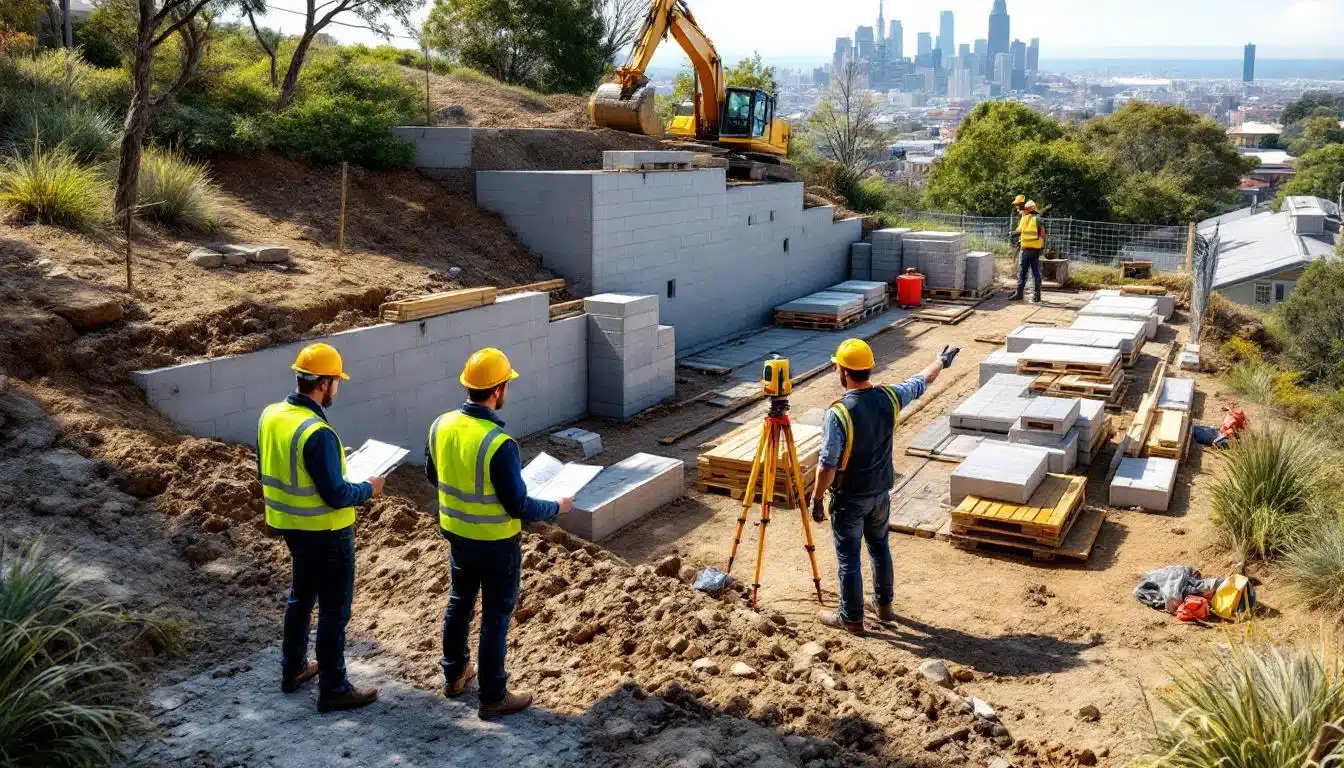
Sloping Block Builders Melbourne: Expert Solutions
Sloping blocks present genuine challenges that most builders aren’t equipped to handle. Poor drainage, complex foundations, and council approval hurdles stop many Melbourne homeowners from pursuing their extension dreams.
At Cameron Construction, we’ve spent years perfecting solutions for sloping block builders in Melbourne. We know exactly how to transform difficult terrain into valuable living space.
What Makes Sloping Blocks So Difficult to Build On
Drainage and Foundation Challenges
Sloping blocks demand far more than standard construction knowledge. The terrain itself creates a cascade of technical and financial challenges that catch most builders off guard. Drainage failures are the most common problem we see on Melbourne sloping sites. Water naturally flows downhill, and if your design doesn’t account for this, you’ll face foundation saturation, mould growth, and structural damage within years. The Victorian Building Authority notes that proper site assessment including geotechnical assessments and structural evaluations are often required on slopes to design appropriate footings and manage on-site effluent capacity. This isn’t optional-it’s essential.
A sloping block also demands different foundation approaches entirely. Standard concrete slabs won’t work on steep terrain. Instead, builders must use piers, posts, or screw piles that accommodate uneven ground and minimise excavation disruption. These foundation systems cost more upfront but prevent the catastrophic expenses of failed conventional footings later.
Planning Rules and Height Restrictions
Melbourne’s planning rules add another layer of complexity. Your building height is measured from natural ground level, not from the prepared site, which means a 2.5-degree slope across an 8-metre width automatically triggers different height allowances under Clause 54 and 55. Side and rear setbacks scale with wall height-the base setback is 1 metre plus 0.3 metres per metre of height over 3.6 metres up to 6.9 metres. Get these calculations wrong and your council application gets rejected.
Cost Implications and Professional Requirements
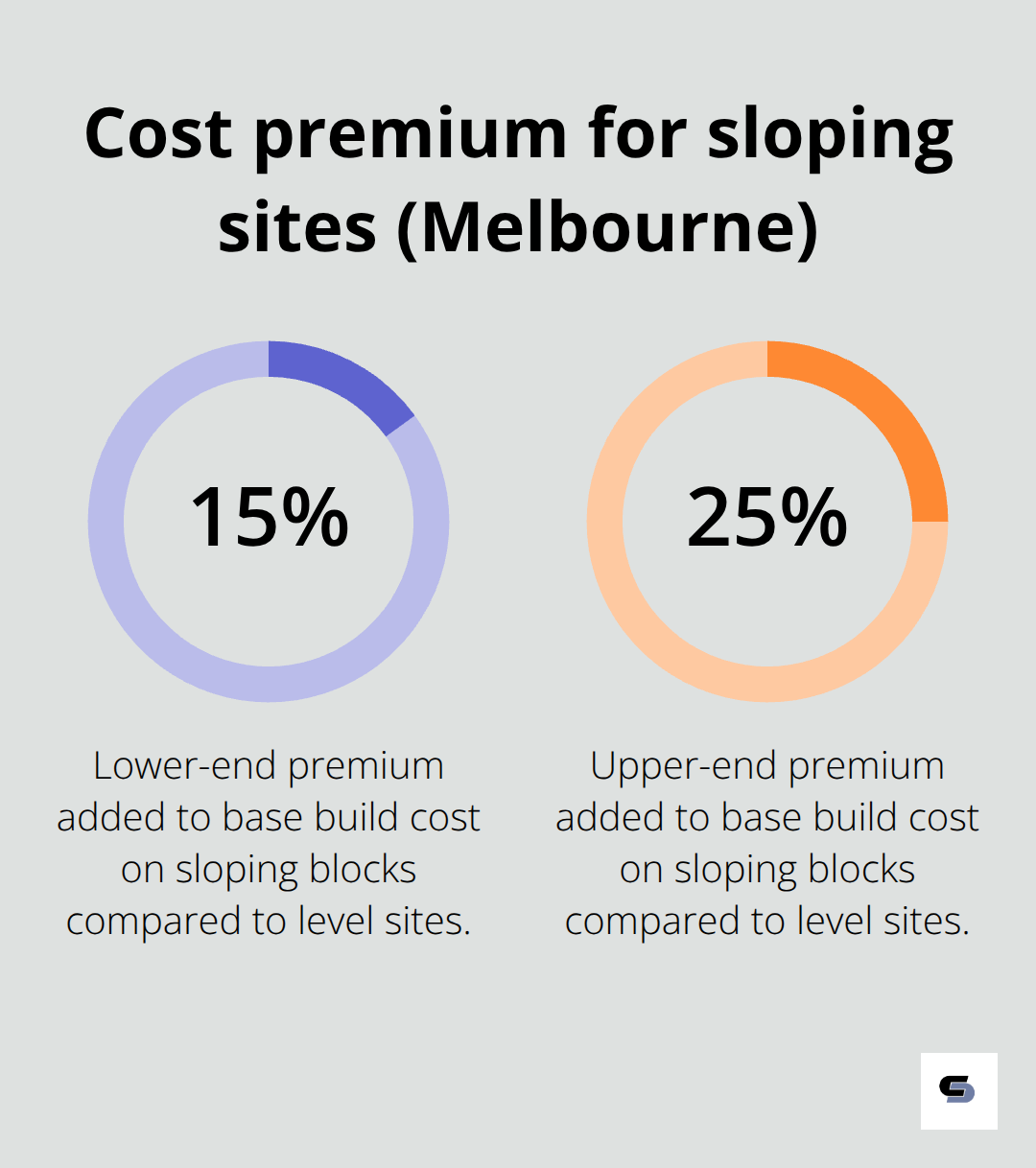
Cost implications hit hard on sloping blocks. Geotechnical assessments are required before construction even starts. Retaining walls, drainage systems, and specialised foundations add 15 to 25 per cent to your base build cost compared to level sites.
Melbourne’s land costs vary significantly across suburbs, but sloping blocks often carry a discount that doesn’t offset the construction premium.
Infrastructure charges and professional fees add roughly 10,000 to 12,000 dollars per Melbourne project, and sloping sites typically require both a registered building surveyor and engineering input, pushing those costs higher. The building surveyor conducts mandatory inspections under the National Construction Code and has enforcement powers to direct fixes for non-compliant work, so their involvement is non-negotiable.
Smart Design Reduces Costs
The real saving comes from smart design that works with the slope rather than against it. Split-level extensions turn a slope into an architectural advantage-upper levels align with natural ground at the rear while lower levels step down toward the street. This approach reduces excavation, improves drainage naturally, and creates more usable space than fighting the terrain with massive retaining structures.
Planning applications for sloping blocks should include pre-application meetings with your local council. These meetings clarify height, setback, and drainage requirements before you invest in full design documentation. Many builders treat sloping blocks as a headache to avoid. However, when you understand the physics and the rules, sloping terrain actually presents an opportunity to create something genuinely distinctive. The key is working with specialists who know how to transform difficult terrain into valuable living space.
How to Turn a Slope Into Usable Living Space
Stepped Foundations: The Cost-Effective Foundation Strategy
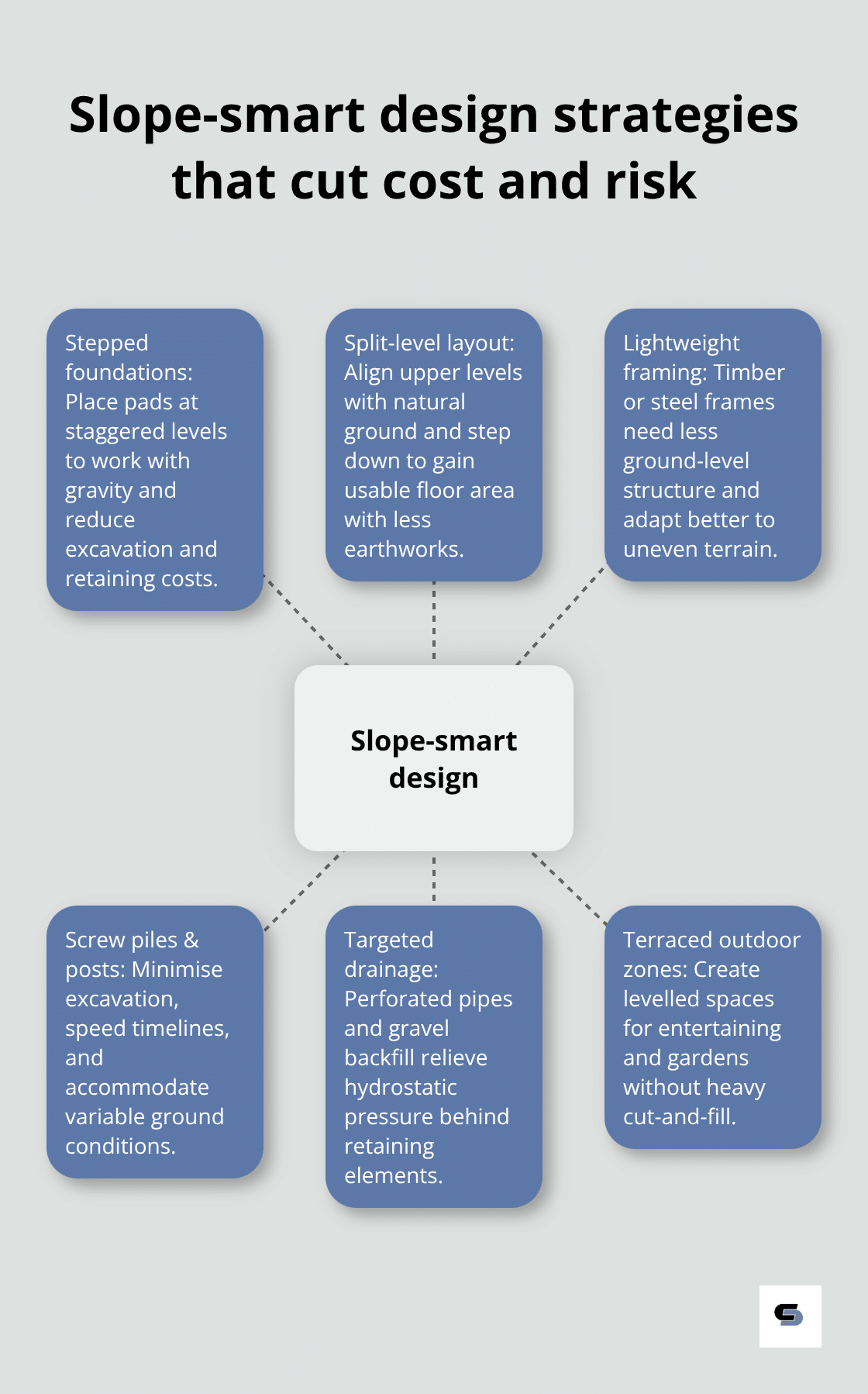
The difference between a failed sloping block project and a successful one comes down to foundation strategy. Stepped foundations paired with retaining walls remain the most cost-effective approach for Melbourne sloping blocks, provided the design works with gravity rather than against it. A stepped foundation system places concrete pads at different levels down the slope, which eliminates the need for massive single retaining walls that can cost $15,000 to $40,000 depending on height and soil conditions.
Each step typically spans 1.5 to 2.5 metres vertically, and the foundation pads sit on undisturbed soil below the slope surface. This method reduces excavation volume significantly compared to conventional cut-and-fill approaches. The Victorian Building Authority requires geotechnical assessment to confirm soil bearing capacity and slope stability before construction starts, so your engineer will specify exactly how many steps your site needs and at what intervals.
Retaining walls between these steps should never exceed 1.2 metres in height without professional design. Walls on property boundaries face strict height limits under Clause 55-typically around 3.2 metres average with a 3.6 metre cap. Drainage behind retaining walls must include perforated pipes and gravel backfill to prevent water pressure buildup, which represents a common failure point on older Melbourne sloping block builds.
Split-Level Extensions: Architecture That Works With Terrain
Split-level extensions transform the slope into an architectural feature rather than a constraint. Upper living areas sit level with natural ground at the rear of your property, while lower spaces step down progressively toward the street frontage. This arrangement means you gain usable floor area without excessive earthworks, and natural daylight reaches lower levels through what would otherwise be buried walls.
A split-level extension typically costs 8 to 12 per cent less per square metre than a conventional extension on the same sloping site because excavation, retaining, and drainage costs drop substantially. On a 300 square metre extension, that saving reaches $24,000 to $36,000. The split-level approach also satisfies Melbourne’s setback and height requirements more easily because upper levels naturally fall within permitted height zones while lower levels occupy areas that would otherwise require deeper cuts.
Lightweight Framing and Foundation Systems
Lightweight framing using timber or steel adapts well to sloping sites and costs less than masonry on uneven ground. Timber framing runs roughly $600 to $800 per square metre installed, while steel runs $800 to $1,100 per square metre, and both outperform concrete block construction on slopes because they require less structural support at ground level. Insulation depth matters here-a 90 millimetre frame delivers R2.0 to R2.5 insulation, while a 140 millimetre frame reaches R3.0 to R3.5, which translates to measurable energy savings over 10 years on a Melbourne home.
Screw piles and post footings work exceptionally well on sloping blocks because they accommodate uneven ground without extensive excavation and speed construction timelines compared to traditional strip footings. These systems reduce site disruption during construction and adapt to the terrain’s natural contours rather than fighting against them.
Maximising Outdoor and Living Space
Private open space on sloping blocks must total at least 80 square metres or 20 per cent of the lot (whichever is lesser, but not less than 40 square metres) under Clause 55, with at least 25 square metres of secluded space having a minimum 3 metre dimension. On a slope, this often means creating terraced outdoor areas at different levels, which actually improves usability compared to a single flat yard because each terrace can serve different purposes-upper levels for entertaining, lower areas for gardens or recreation.
The real advantage of working with specialists lies in their ability to see how foundation strategy, framing choice, and spatial planning combine to unlock value that standard builders miss. When your extension design aligns with the slope’s natural geometry, costs drop and functionality improves. This foundation knowledge becomes essential when you move into the planning approval phase, where council assessors scrutinise every detail of your design’s compliance with height, setback, and drainage requirements.
Why Specialist Builders Handle Sloping Blocks Better
Most Melbourne builders treat sloping blocks as a liability rather than an opportunity, which is why so many projects stall at the planning stage or blow out in cost during construction. Standard builders approach sloping blocks the same way they approach level sites, then discover halfway through that foundation assumptions were wrong or council inspectors flag setback violations. This approach costs you money and delays.
Engineering Expertise Sets Specialists Apart
Specialist sloping block builders invest time upfront in geotechnical assessment, soil testing, and detailed engineering before quoting. A soil report is a requirement of a building permit, so a builder who skips this step cuts corners that will damage your project later. Standard builders often default to conventional strip footings because that’s what they know, even when better alternatives exist for your particular site. Screw piles and post footings reduce excavation costs compared to strip footings on slopes, but only if your structural engineer specifies them correctly from the start.
Planning Compliance and Council Approvals
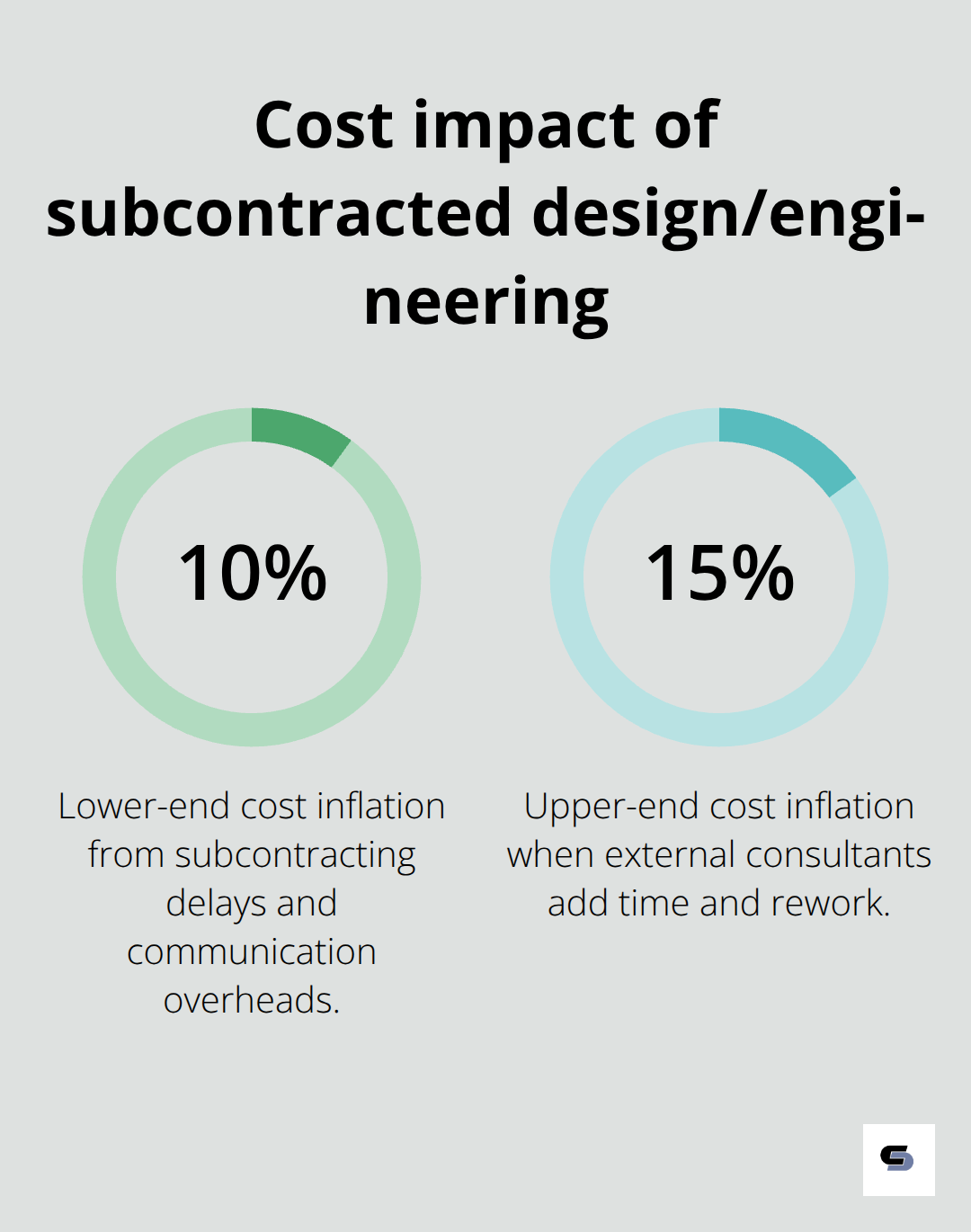
Specialists know exactly which height calculations, setback formulae, and drainage specifications each Melbourne council will scrutinise. When your extension design includes a split-level approach with stepped foundations, the planning application becomes straightforward because the design already complies with Clause 54 and 55 requirements rather than seeking variations that councils often reject. A builder who subcontracts engineering and design to external consultants adds time and communication delays that inflate costs by 10 to 15 per cent. On a $500,000 extension, that represents $50,000 to $75,000 in unnecessary expense.
Integrated Design and Construction Planning
The real advantage of working with specialists emerges during the integrated design and build phase. Design, engineering, and construction planning happen in parallel, which means foundation strategy informs architectural layout, framing choices reflect site constraints, and cost estimates stay accurate because they’re based on actual site conditions rather than assumptions. This parallel approach prevents the costly remedial work that occurs when design and construction operate separately.
Building Surveyor Inspections and Compliance
When building surveyor inspections occur during construction, they verify compliance with the National Construction Code. Specialists anticipate those inspection points during design, so inspections pass cleanly rather than creating costly remedial work. Building surveyors have enforcement powers and can direct fixes for non-compliant work, which delays schedules and adds expense if your contractor wasn’t anticipating inspection requirements. A team that understands inspection protocols from the outset avoids these penalties entirely.
Final Thoughts
Sloping block builders Melbourne transform terrain that stops most contractors cold. The difference between a failed project and a successful one comes down to whether your builder understands foundation strategy, planning compliance, and how to design with the slope rather than against it. Experienced builders invest in proper geotechnical assessment and engineering before quoting, which means your foundation strategy is correct from day one rather than discovered mid-construction.
Your local council’s pre-application meeting clarifies height, setback, and drainage requirements before you invest in full design documentation. This conversation prevents wasted design work and identifies planning obstacles early. Soil testing and geotechnical assessment inform foundation strategy and cost estimates that actually reflect your site’s conditions, so engage a builder who conducts these reports as standard practice.
We at Cameron Construction handle sloping block extensions from concept through completion, including planning, permits, and BCA compliance across Melbourne’s councils. Our in-house designers and engineers work together to create solutions that turn difficult terrain into valuable living space. Contact us to discuss how specialist experience transforms your extension plans into reality.