Second Storey Additions: Complete Guide
Second storey additions transform Melbourne homes by adding valuable living space without sacrificing your backyard. At Cameron Construction, we’ve guided hundreds of homeowners through this complex process, from initial planning through to final handover.
This guide covers everything you need to know: structural assessments, council permits, design considerations, and realistic costs. Whether you’re adding a bedroom, study, or expanding your family home, we’ll walk you through each stage so you can make informed decisions.
Getting Your Second Storey Addition Approved
Structural Assessment: The Foundation of Your Project
A second storey addition requires three critical steps: understanding what your home can structurally support, navigating Melbourne’s council approval process, and setting a realistic budget. Your builder must inspect your current foundations, walls, and roof to determine load capacity. Consumer Affairs Victoria recommends that builders obtain a soil report and foundation data before pricing any work over $10,000, which nearly every second storey addition exceeds. This assessment isn’t optional-it forms the foundation for an accurate quote and safe construction.
Most Melbourne properties sit on variable soil types, from clay around the inner suburbs to sand in outer areas, and each responds differently to additional weight. A structural engineer reviews your existing footings, wall thickness, and timber quality to identify what reinforcement you’ll need. This assessment typically costs $800 to $1,500 and takes one to two weeks.
Council Permits and Planning Requirements
Melbourne’s council approval process depends entirely on your property’s zone and size. If your land is under 300 square metres in a General Residential Zone or Residential Growth Zone, you’ll need a planning permit. Properties in Low Density Residential, Mixed Use, Rural Conservation, or Green Wedge zones also require permits regardless of size. You can check your exact zone using VicPlan, the Victorian Government’s online mapping tool.
Contact your local council’s planning department early-this conversation often saves months of wasted effort. Some councils allow VicSmart assessment, a faster pathway for minor works including single dwelling extensions in residential zones, which can reduce approval time from 60 days to just 10 working days. Beyond planning approval, you’ll need a building permit from the Victorian Building Authority before construction starts.
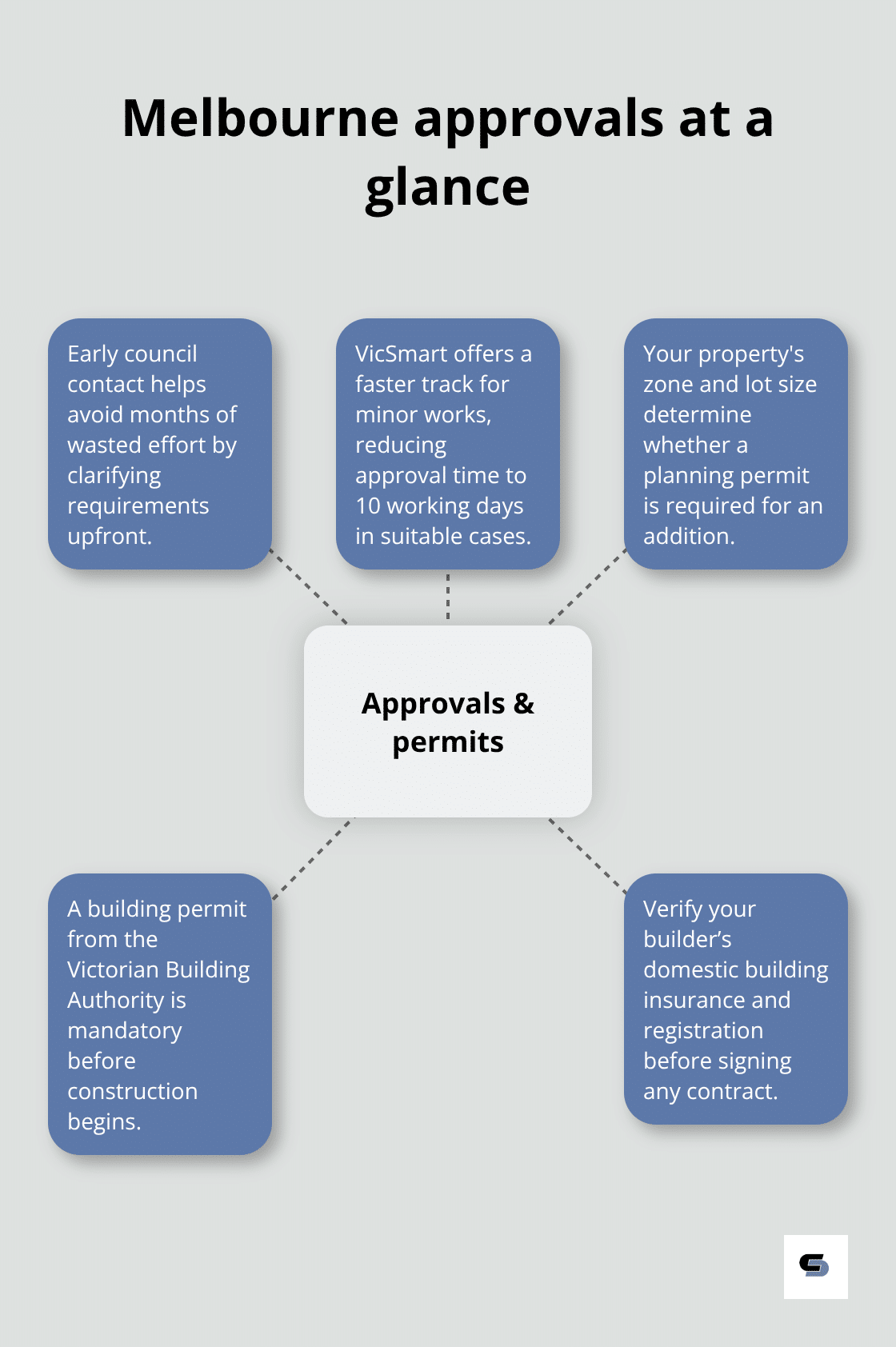
If your project costs over $10,000, your builder must hold current domestic building insurance and a registration certificate from the Building and Plumbing Commission. Verify this registration on the BPC website before you sign any contract. Both permits are non-negotiable-construction without them creates legal liability and makes future sales problematic.
Budget Reality and Cost Protection
Second storey additions in Melbourne typically cost between $3,500 and $5,500 per square metre for a basic build, though premium finishes and complex sites push this higher. Consumer Affairs Victoria advises you to obtain at least three written quotes with identical specifications to compare fairly. Never accept quotes that bundle prime cost or provisional sum items-these are budget killers that hide actual costs until construction begins.
Your contract must specify every fixture, fitting, and material in detail. Any variation to the contract must be written and signed by both parties; verbal agreements about changes lead directly to disputes. Stage-by-stage payment aligned with construction milestones-base, frame, lock-up, and fixing-protects your investment if quality issues arise. You pay only when you’re satisfied each stage is complete.
Building a proper team matters more than finding the cheapest option. Include a building lawyer to review your contract; the Law Institute of Victoria can help you find independent legal advice. An independent building surveyor appointed by you (not your builder) verifies quality at each stage. These professionals cost extra upfront but prevent expensive problems later. Budget contingency at 10–15% of your total project cost for unforeseen structural issues or council requirement changes-these surprises happen on most older Melbourne homes.
Moving Forward With Design and Engineering
Once you’ve confirmed your property can support a second storey addition and understand your council’s requirements, the design phase begins. Your builder and design team work together to translate your vision into compliant plans that satisfy both planning and building regulations.
Turning Plans Into Compliant Structures
Your soil report confirms what your home can support, and council permits sit in hand. Now your design must translate those approvals into a buildable reality. Structural engineers specify every reinforcement detail your existing home requires-this isn’t theoretical work. Your engineer calculates exact footing depths, wall bracing requirements, and roof load paths based on your soil report data and current structure.
A second storey addition requires underpinning or deepening footings on older Melbourne homes because original foundations were designed for single-storey loads only. Your engineer produces detailed construction drawings that your builder follows precisely; these drawings become the contract documents that protect you if disputes arise. Many homeowners underestimate this phase, but a structural engineer’s involvement at design stage prevents costly mid-construction discoveries. The design process takes 4–8 weeks depending on site complexity and council feedback cycles.
How BCA Standards Vary Across Melbourne
The Building Code of Australia sets minimum standards, but Melbourne councils interpret and enforce these standards differently. Some councils demand stricter thermal performance than others; the City of Melbourne often requires higher insulation values than outer-suburban councils. Your builder lodges a building permit with the Victorian Building Authority, and your certifier-either your council or a private building surveyor-verifies compliance at each stage.
Energy efficiency standards have tightened significantly in recent years, and a second storey addition is the ideal time to upgrade your entire home’s thermal performance. Rather than treating the addition in isolation, your design should address insulation in existing roof spaces, wall cavities, and floors where the new structure connects. The thermal bridging at junctions between old and new construction creates weak points if not properly designed; your structural engineer and building designer must coordinate these details.
Managing Where Old Structure Meets New
The most complex aspect of second storey additions is managing where new structure meets existing walls and roof. Your existing brick veneer walls may not have the strength to support a second storey without internal bracing or reinforcement. Roof trusses designed for single-storey loads must be replaced or substantially reinforced.
Your builder removes the existing roof carefully-this is destructive work that requires planning to protect the interior from weather exposure. Most second storey additions require temporary roof structures during construction, adding 2–3 weeks to the timeline and $8,000–$15,000 to costs. Your design drawings must show exactly how new structural elements sit on existing foundations and walls, with calculations proving the connections are adequate. A structural engineer’s miscalculation means tearing into completed work to add reinforcement after discovery, triggering insurance and variations disputes.
Your builder’s experience matters enormously here because they’ve seen what actually works on Melbourne’s diverse housing stock-what works on a 1970s weatherboard home differs significantly from a 1920s brick home with lime mortar joints. This phase of construction, from roof removal through lock-up of the new second storey, is the riskiest period. Your independent building surveyor should inspect daily during this phase rather than at standard intervals, catching problems before they compound.
Protecting Your Investment During High-Risk Phases
Weather exposure during roof removal creates the greatest risk to your home’s interior and your budget. Your builder must coordinate temporary weather protection, material deliveries, and subcontractor scheduling to minimise exposure time. Insurance coverage becomes critical here-confirm that your home and contents insurance covers renovations and consider extra coverage if needed. Any water damage during this phase falls outside standard policies if your builder hasn’t taken proper precautions.
Structural surprises emerge frequently once walls open up. Hidden timber decay, inadequate original construction, or soil movement that wasn’t visible in the soil report can force design changes mid-project. Your 10–15% contingency budget absorbs these discoveries without derailing your timeline. Your builder communicates these findings immediately rather than proceeding with work that won’t meet code requirements.
With your structural design finalised and the high-risk construction phases understood, your attention shifts to the practical realities of managing costs and timelines throughout the build.
What Second Storey Additions Actually Cost and How Long They Take
Second storey additions in Melbourne range from $3,500 to $5,500 per square metre for standard construction, but this figure masks the real complexity of budgeting. A 40-square-metre addition costs between $140,000 and $220,000 before permits, contingencies, and site-specific challenges. Structural surprises emerge on approximately 70% of older Melbourne homes once walls open, pushing final costs 15–25% above initial quotes. Your soil report ($800–$1,500) and structural engineer fees ($2,000–$4,000) occur before construction starts, and these are non-negotiable expenses that determine whether your project is financially viable.
Breaking Down Your Budget
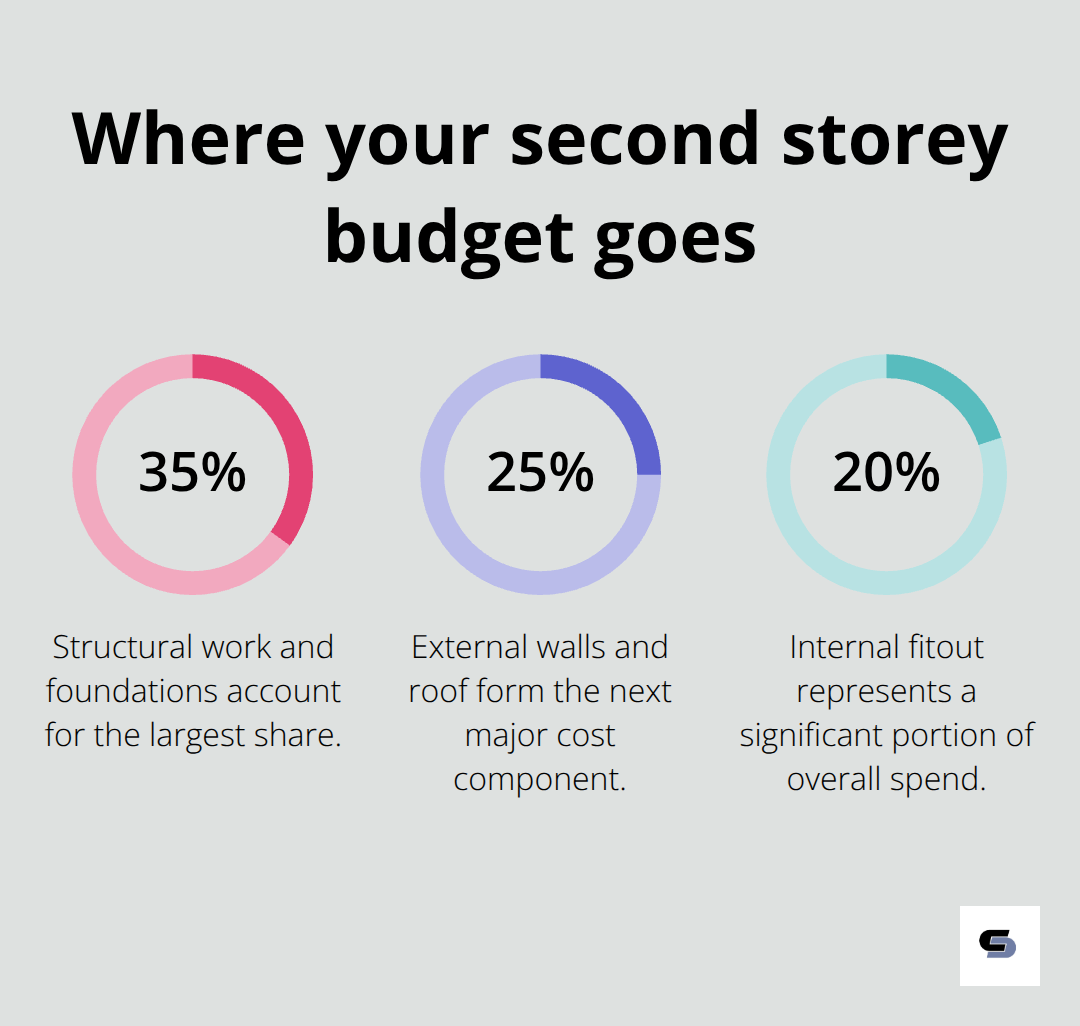
The actual cost splits roughly 35% to structural work and foundations, 25% to external walls and roof, 20% to internal fitout, and 20% to services (electrical, plumbing, mechanical). Premium finishes, complex roof geometries, or heritage overlay constraints add $500–$1,500 per square metre. Underpinning or footings reinforcement on older homes costs $15,000–$40,000 depending on soil conditions and existing foundation depth.
Your builder’s quote should itemise every structural element separately so you understand where money goes, not bundle costs into vague categories. Three written quotes with identical specifications reveal genuine price differences-quotes varying by more than 20% signal either missing scope in the cheapest option or unnecessary work in the expensive one. Never accept prime cost or provisional sum items that hide actual costs; your contract must specify exact products, materials, and labour rates.
Protecting Your Cash Flow
Stage payments aligned to construction milestones-typically base and footings (20%), frame and lock-up (35%), fixing and services (35%), and final completion (10%)-protect your cash flow and give you leverage if quality issues arise. Your builder’s insurance and registration with the Building and Plumbing Commission isn’t optional; verify this on the BPC website before depositing funds.
Timeline Expectations
Planning approval takes 10 working days under VicSmart pathways or 60 days through standard assessment; councils outside Melbourne’s CBD often process faster than inner-city councils. Building permit approval typically takes 5–10 working days once submitted with complete documentation. Construction itself takes 4–6 months for a standard second storey addition, though this stretches to 7–9 months on constrained sites or heritage properties.
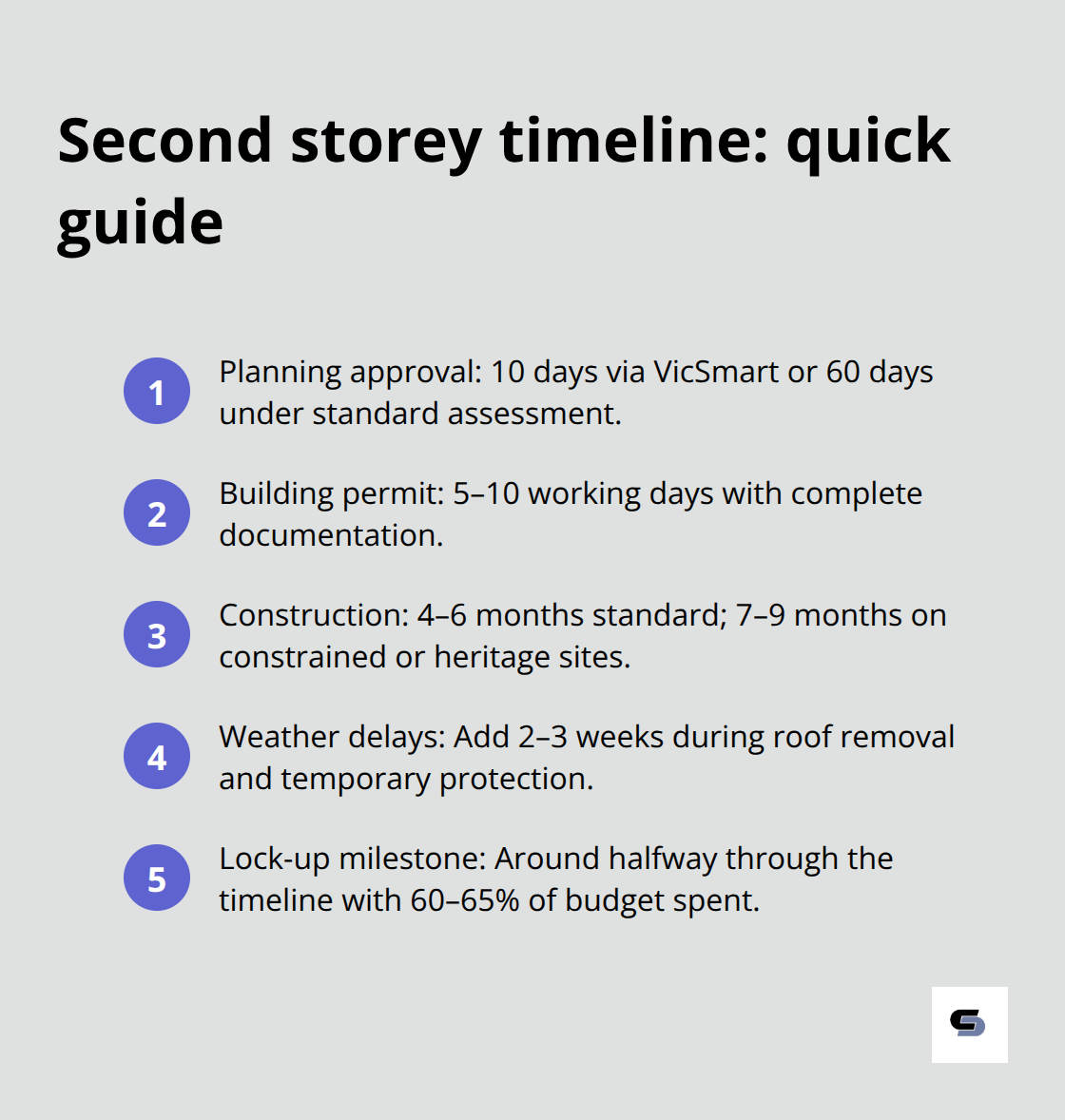
Weather delays during roof removal and temporary weather protection setup add 2–3 weeks almost universally-this isn’t avoidable on Melbourne homes. Your builder should provide a detailed project schedule showing when structural engineers inspect, when council inspections occur, and when specific trades mobilise; vague timelines signal poor planning. The lock-up phase (frame complete, roof on, windows installed) typically marks the halfway point in timeline but only 60–65% of budget spent because interior work accelerates after weather protection is complete.
Managing Inspections and Delays
Most delays stem from council inspection scheduling rather than builder performance; book inspections weeks in advance rather than waiting for work completion. Your independent building surveyor should inspect at minimum weekly during structural phases and twice weekly when old roof meets new structure-this catches problems before they multiply.
Protecting Your Investment
A building lawyer should review your contract before signing; the Law Institute of Victoria can connect you with independent legal advisors. Your home and contents insurance must explicitly cover renovations; standard policies exclude damage during construction. Weather protection during roof removal is your builder’s responsibility, but confirm in your contract that they carry insurance covering water damage if weather protection fails. Contingency budgets of 10–15% absorb structural discoveries without derailing your timeline or forcing quality compromises; many homeowners treat contingency as optional and regret this decision when decay or inadequate original construction emerges.
Final Thoughts
Second storey additions succeed when you combine structural reality with professional expertise and realistic budgeting. The three foundations of any successful project are understanding what your home can structurally support, navigating council approvals correctly, and protecting your investment through proper contracts and staged payments. Structural assessments determine whether your project is viable and what reinforcement your existing home requires, while council permits vary significantly across Melbourne’s zones and overlays, making early conversations with your planning department essential.
Professional guidance matters because second storey additions involve multiple specialists working in sequence-structural engineers, building designers, council inspectors, and licensed trades. Your builder’s experience with Melbourne’s diverse housing stock, from 1920s brick homes to 1970s weatherboard properties, directly influences whether your project runs smoothly or encounters expensive mid-construction discoveries. Building lawyers, independent surveyors, and structural engineers cost extra upfront but prevent disputes that cost far more later.
Contact a builder experienced in second storey additions and request a structural assessment of your home. Bring your soil report and council zone information to your first meeting, then obtain three written quotes with identical specifications and review them with a building lawyer. Cameron Construction can guide you through each stage, from concept to completion, ensuring your second storey addition delivers the space and value you’re planning for.