Melbourne Extension Pricing Guide: Budgeting Your Dream Extension
Extension costs in Melbourne vary dramatically depending on the type of work you’re planning. We at Cameron Construction have helped hundreds of homeowners understand what they’ll actually spend on double storey extensions, ground floor additions, and second storey conversions.
This Melbourne extension pricing guide breaks down real costs, the factors that drive them, and how to set a budget that works for your project.
Cost Breakdown for Different Extension Types
Double Storey Extensions
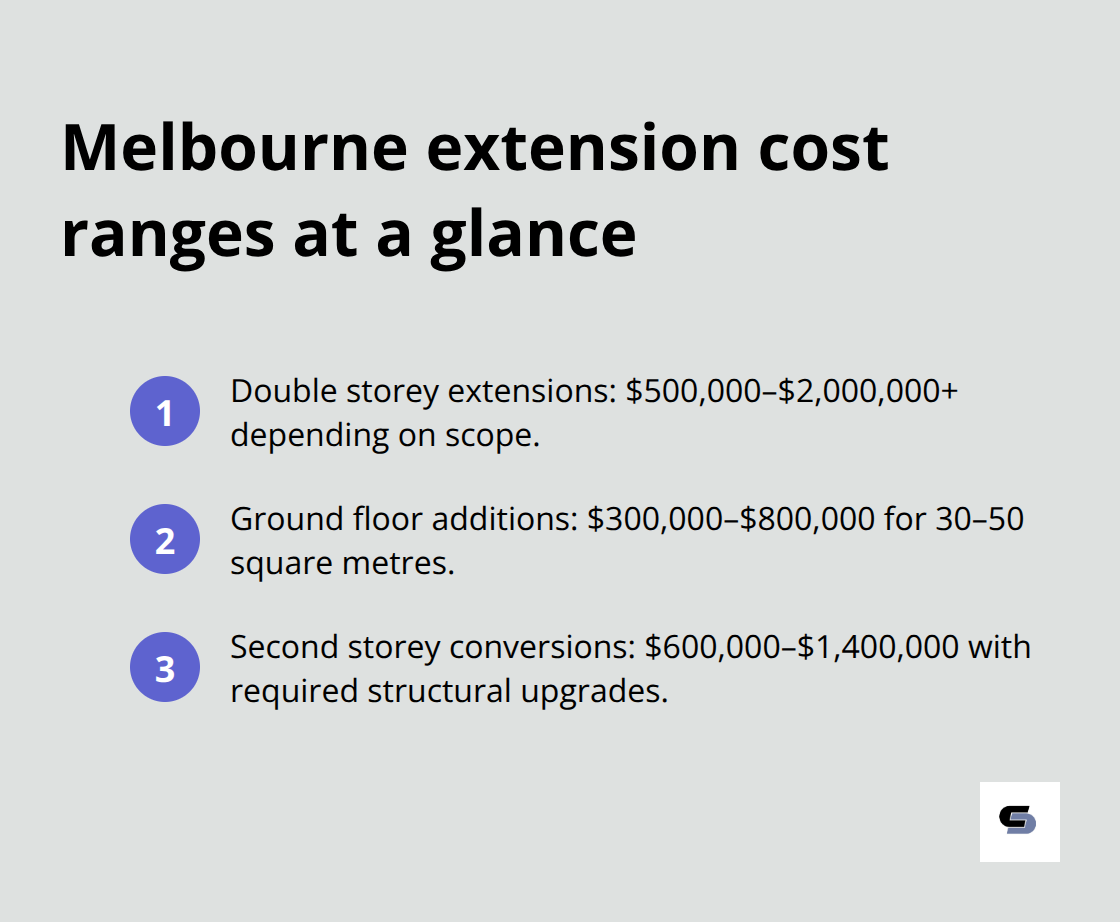
Double storey extensions represent the largest investment Melbourne homeowners make, typically ranging from $500,000 to $2,000,000+ depending on size, materials, and site complexity. A modest 40–60 square metre addition with standard finishes costs around $800,000 to $1,200,000, while premium builds with high-end kitchens, bathrooms, and architectural detailing push towards $1,500,000. Metropolitan residential construction increased 4.3% in calendar year 2025, meaning budgets established last year need adjustment upward. Planning permit fees for a double storey extension in Melbourne start at $1,697.80 for projects valued $1,000,000 to $2,000,000, then escalate significantly for larger developments.
Ground Floor Additions
Ground floor additions cost considerably less-typically $300,000 to $800,000 for a 30–50 square metre space-because they avoid the structural complexity and multi-level coordination that double storey work demands. A straightforward ground floor family room or bedroom extension with standard fixtures sits around $400,000 to $600,000. Permit costs for ground floor work depend on total project value; a $400,000 addition falls into the $100,000–$500,000 bracket at $1,462.50 for the planning permit alone.
Second Storey Conversions
Second storey conversions occupy a middle ground, costing $600,000 to $1,400,000 because they involve retrofitting structural supports, new stairs, and often foundation reinforcement to handle additional weight. These projects face higher engineering demands than ground floor additions but typically avoid the scale complexity of a full double storey build.
Material Specifications and Site Conditions
Material specifications and site conditions create the widest cost variations within each category. A double storey extension using brick veneer and standard timber joinery costs 15–20% less than one clad in rendered blockwork with exposed timber beams and architectural glazing. Sloping blocks, poor soil conditions, or proximity to heritage overlays add $50,000 to $150,000 in extra engineering, survey work, and compliance measures. Melbourne councils impose development contribution levies on projects increasing dwelling numbers or floor area; these contributions vary by location but typically add $10,000 to $40,000 to total project costs. Building costs also vary between metropolitan Melbourne and regional Victoria, reflecting transport and labour supply differences.
Foundation Assessment and Permit Complexity
For second storey conversions, foundation assessment is non-negotiable; inadequate soil reports lead to design rework and cost blowouts averaging $20,000 to $60,000. Ground floor additions on well-prepared sites with good soil often proceed without surprises, but extensions on clay or reactive soils require deeper footings and moisture barriers, adding 8–12% to construction costs. Permit fees compound quickly when projects require multiple approvals; applying for both a planning permit and a building permit simultaneously means the highest individual fee applies, plus 50% of secondary fees, so a complex double storey project can incur $4,000 to $6,000 in permits alone before construction starts. Understanding these cost drivers upfront shapes how you approach the next critical phase: identifying which factors will most affect your specific project.
Factors That Impact Extension Costs
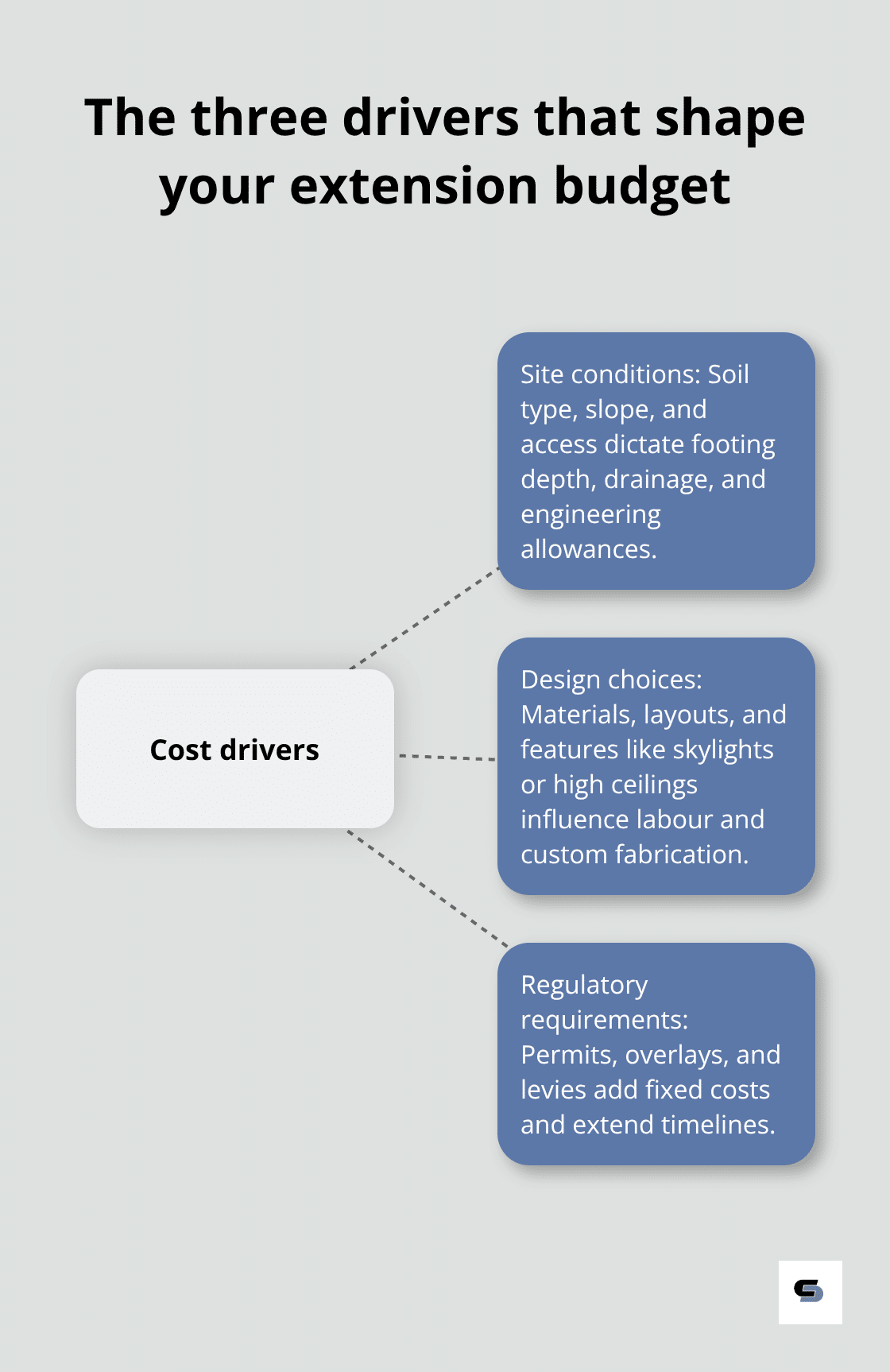
Your extension budget hinges on three interconnected factors that rarely operate in isolation. Site conditions, design choices, and regulatory requirements interact in ways that compound costs unpredictably, which is why understanding each one separately matters less than seeing how they collide on your specific block. Poor soil conditions don’t just add engineering fees; they force design changes that ripple through materials, timelines, and permits.
A sloping block with clay soil and a heritage overlay creates a cost multiplier effect that a flat, well-drained site never encounters. The Valuer-General Victoria building cost indexation factors show metropolitan residential construction rose 4.3% in calendar year 2025, but your actual project cost increase depends heavily on site-specific demands that inflate labour and material requirements beyond the baseline index.
Site Conditions and Soil Assessment
Your soil report determines whether your extension sits on stable ground or requires expensive remedial work. A standard soil assessment costs $1,500 to $3,000, but the findings dictate foundation depth, moisture barriers, and structural reinforcement. Melbourne’s clay soils, particularly in suburbs like Camberwell, Balwyn, and Box Hill, swell and shrink seasonally; extensions on these sites need deeper footings and moisture management systems that add 8–12% to construction budgets. Reactive soils in outer suburbs and regional Victoria impose even steeper costs because they demand specialised engineering and ongoing monitoring. Sandy or well-drained soils reduce foundation complexity and often allow standard footing depths, saving $15,000 to $40,000 on a double storey project. Sloping blocks multiply these costs again; a 1-in-3 slope requires retaining walls, cut-and-fill work, and additional drainage infrastructure that can add $50,000 to $100,000 before you pour a single cubic metre of concrete. Second storey conversions face the harshest soil demands because existing foundations rarely support additional weight without reinforcement. Comprehensive soil and foundation reports before design work begins protect your budget, because foundation surprises discovered mid-construction derail budgets by $20,000 to $60,000 and delay timelines by months.
Design Complexity and Material Selection
Material choices create the widest cost variation within each extension type, yet homeowners often underestimate their impact. Brick veneer with standard joinery costs 15–20% less than rendered blockwork with exposed timber beams and architectural glazing. Upgrading from standard kitchen cabinetry to custom joinery adds $20,000 to $50,000; choosing imported stone benchtops instead of engineered surfaces adds another $8,000 to $15,000. Architectural features like high ceilings, skylights, and integrated outdoor connections demand custom engineering that increases design fees and construction complexity. Your design complexity also interacts with site constraints; a heritage-listed property needs heritage-compliant materials and design approval processes that add $5,000 to $20,000 in consulting fees and extend permit timelines by 8–12 weeks. Sloping blocks or narrow access impose design constraints that force non-standard layouts, custom structural solutions, and increased labour costs. A straightforward rectangular extension on a flat, accessible block costs 20–30% less to construct than a complex design on a constrained site, even if both projects have identical square metreage.
Permit Fees and Approval Complexity
Planning permit fees scale directly with project value, but complexity adds hidden costs that most homeowners miss. A double storey extension valued between $1,000,000 and $2,000,000 attracts a planning permit fee of $1,697.80, yet if your project requires multiple approvals-a planning permit, a building permit, a heritage assessment, and a development contributions plan levy-the total fee structure compounds quickly. When you apply for multiple planning matters simultaneously, the highest individual fee applies plus 50% of each secondary fee; a complex project can incur $4,000 to $6,000 in permits alone. Development contribution levies apply to projects increasing dwelling numbers or floor area and vary by council location, typically adding $10,000 to $40,000. If your estimated development value exceeds $1,311,000 for 2025–26, the metropolitan planning levy applies at $1.30 per $1,000 of development value-a 0.13% additional cost that homeowners rarely budget for until late in the approval process. Heritage overlays, neighbourhood character zones, and vegetation protection overlays trigger additional assessment requirements and fees. Advertising costs for planning applications add another $1,500 to $3,000 when you factor in site notices, newspaper notices, and council notifications. Extensions on constrained sites with multiple overlays face permit timelines of 12–16 weeks instead of 6–8 weeks, extending your project timeline and carrying costs. These approval costs are fixed and unavoidable; ignoring them in your initial budget estimate guarantees a shortfall when invoices arrive. Understanding these three cost drivers prepares you to set a realistic budget that accounts for your specific site, design ambitions, and regulatory landscape.
How to Budget for Your Extension Project
Setting a realistic budget means working backwards from your actual costs, not forwards from a number you wish to spend. Start with a detailed cost estimate broken into five distinct phases: design and approvals, permits and fees, construction labour, materials, and contingency. For a double storey extension valued at $1,200,000, allocate roughly 8–12% for design fees ($96,000–$144,000), 0.5–1% for permits and council fees ($6,000–$12,000), 40–45% for labour ($480,000–$540,000), 35–40% for materials ($420,000–$480,000), and 5–10% for contingency ($60,000–$120,000). This breakdown shifts for ground floor additions; labour and materials dominate a $500,000 project more heavily because design complexity and permit costs represent a smaller percentage of the total.
The Valuer-General Victoria building cost indexation shows metropolitan residential construction rose 4.3% in calendar year 2025, so a budget established in early 2024 needs upward adjustment. If your soil report reveals reactive clay or a sloping block, add 8–12% immediately to your labour estimate because foundation work, retaining walls, and drainage systems consume budget faster than standard construction. Heritage overlays or neighbourhood character zones add $5,000–$20,000 in consulting fees and stretch permit timelines by 8–12 weeks, increasing carrying costs.
Mandatory Fees and Levies
Melbourne councils charge development contribution levies on projects increasing dwelling numbers or floor area, typically $10,000–$40,000 depending on location; these are mandatory, not optional, so they must sit in your core budget, not your contingency. A metropolitan planning levy at $1.30 per $1,000 of development value applies if your estimated development value exceeds $1,311,000 for 2025–26, adding another 0.13% that catches most homeowners off guard. Advertising costs for planning applications add another $1,500 to $3,000 when you factor in site notices, newspaper notices, and council notifications.
Payment Schedules and Contract Protection
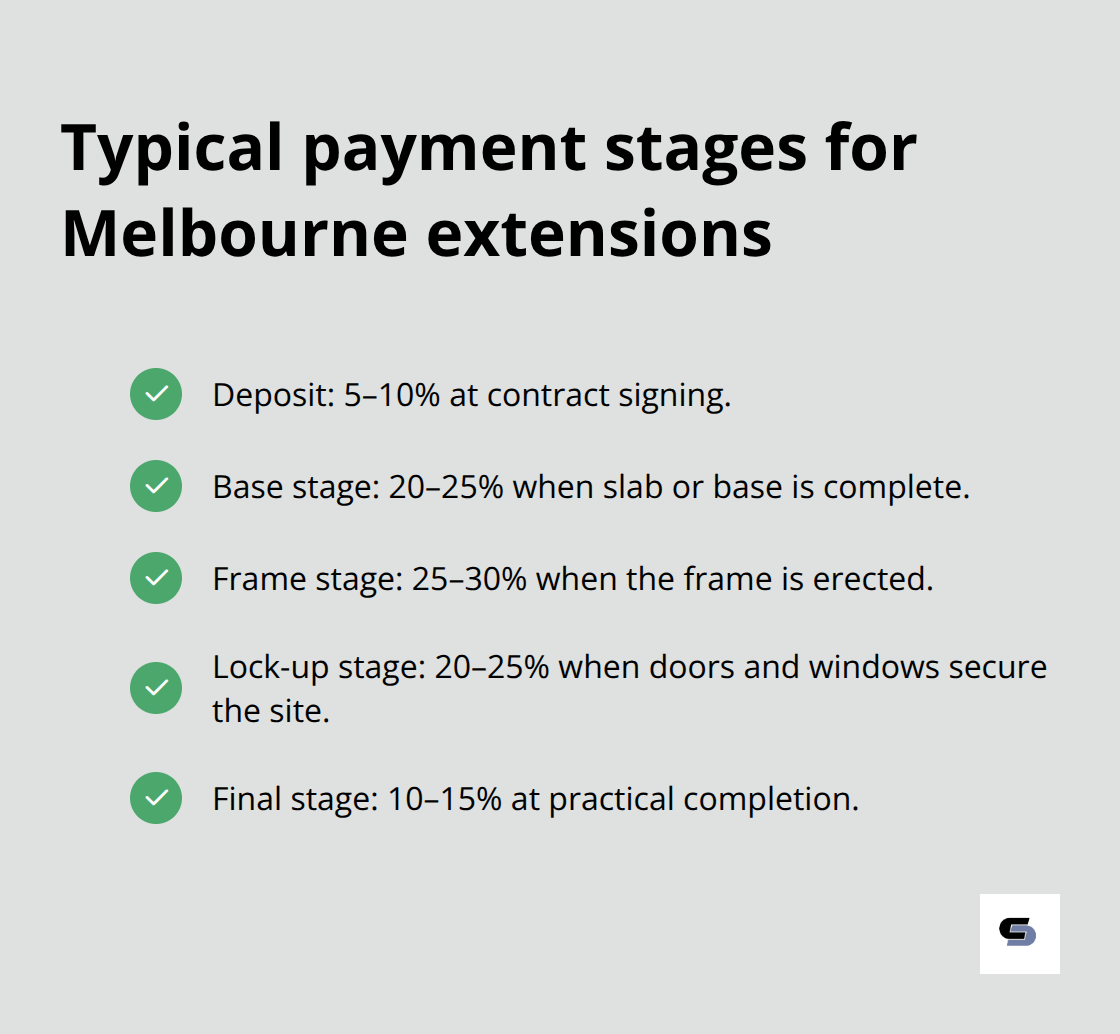
Payment schedules follow a staged approach: deposit (typically 5–10%), base stage (20–25%), frame stage (25–30%), lock-up stage (20–25%), and final stage (10–15%). Never pay the full deposit upfront; staged payments tied to completion milestones protect your position if work quality falls short or the builder fails to progress.
Variations to the contract must be in writing and signed before work proceeds; undocumented changes create disputes and cost blowouts. Your building lawyer should review the contract before signing, clarifying who obtains permits, who manages variations, and what happens if costs exceed estimates.
Contingency Planning and Budget Adjustments
Contingency funds separate from your main budget act as a buffer for soil surprises, design changes, or unforeseen structural work; 5–10% of your total project cost is standard, but projects on complex sites warrant 10–15%. Ground floor additions face fewer surprises than double storey work or second storey conversions, so contingencies can sit at the lower end of the range. Second storey conversions demand higher contingency reserves because foundation reinforcement often reveals problems only once excavation begins. If your project spans multiple financial years, material costs may shift; the 4.3% rise in 2025 suggests budgets should assume ongoing pressure on pricing.
Builder Selection and Quote Comparison
Request at least three written quotes from registered builders and compare them against your detailed plans and specifications; quotes missing detail or using provisional sums indicate builders unwilling to commit to fixed pricing, a red flag for cost control. Verify builder registration with the Building and Plumbing Commission and check their business history with ASIC before signing; this takes one hour and prevents costly disputes later. Construction timelines typically run 12–18 months for double storey extensions, 8–12 months for ground floor additions, and 10–14 months for second storey conversions, but permit delays can add 2–4 months if your application faces objections or requires additional assessments. Weather delays in Melbourne’s winter months (June–August) are common; factor this into your timeline expectations. Your budget is not fixed once set; it evolves as permits are obtained, soil reports arrive, and design details solidify, so review and adjust your estimates quarterly as new information emerges.
Final Thoughts
Extension costs in Melbourne hinge on three interconnected factors: your site conditions, design choices, and regulatory requirements. A double storey extension costs $500,000 to $2,000,000+, ground floor additions run $300,000 to $800,000, and second storey conversions sit between $600,000 and $1,400,000, with these ranges shifting dramatically based on soil type, material selection, and permit complexity. Building cost indexation rose 4.3% in calendar year 2025, meaning budgets need upward adjustment from previous years.
Your budget must account for design fees (8–12%), permits and council levies (0.5–1%), labour (40–45%), materials (35–40%), and contingency (5–10%), with development contribution levies adding $10,000 to $40,000 depending on your council location. A soil report costs $1,500 to $3,000 but saves $20,000 to $60,000 in foundation surprises, while heritage assessments and neighbourhood character zone reviews add $5,000 to $20,000 in consulting fees and prevent permit rejections that delay projects by months. Metropolitan planning levies apply at $1.30 per $1,000 if your project exceeds $1,311,000, so these fixed costs belong in your core budget from day one.
We at Cameron Construction have guided hundreds of Melbourne homeowners through this process, handling design, engineering, permits, and construction from concept to completion. Contact us for a detailed cost estimate tailored to your site, design ambitions, and regulatory landscape. Your Melbourne extension pricing guide starts with a conversation about what you want to build and what your block demands.