Fixed Price Extensions Melbourne: Transparent Budgets for Your Renovation
Extension budgets blow out. Homeowners in Melbourne face unexpected costs that derail their renovation plans, leaving them stressed and financially exposed.
Fixed price extensions Melbourne offer a different path. At Cameron Construction, we’ve seen how transparent, locked-in pricing transforms the renovation experience, giving homeowners genuine control over their spending from day one.
What Fixed Price Actually Locks In
A fixed price contract commits the builder to complete your extension for a predetermined amount, regardless of circumstances during construction. The contract price covers labour, materials, and all specified works from day one to handover. If costs rise-whether timber prices spike or unforeseen soil conditions emerge-the builder absorbs those increases, not you.
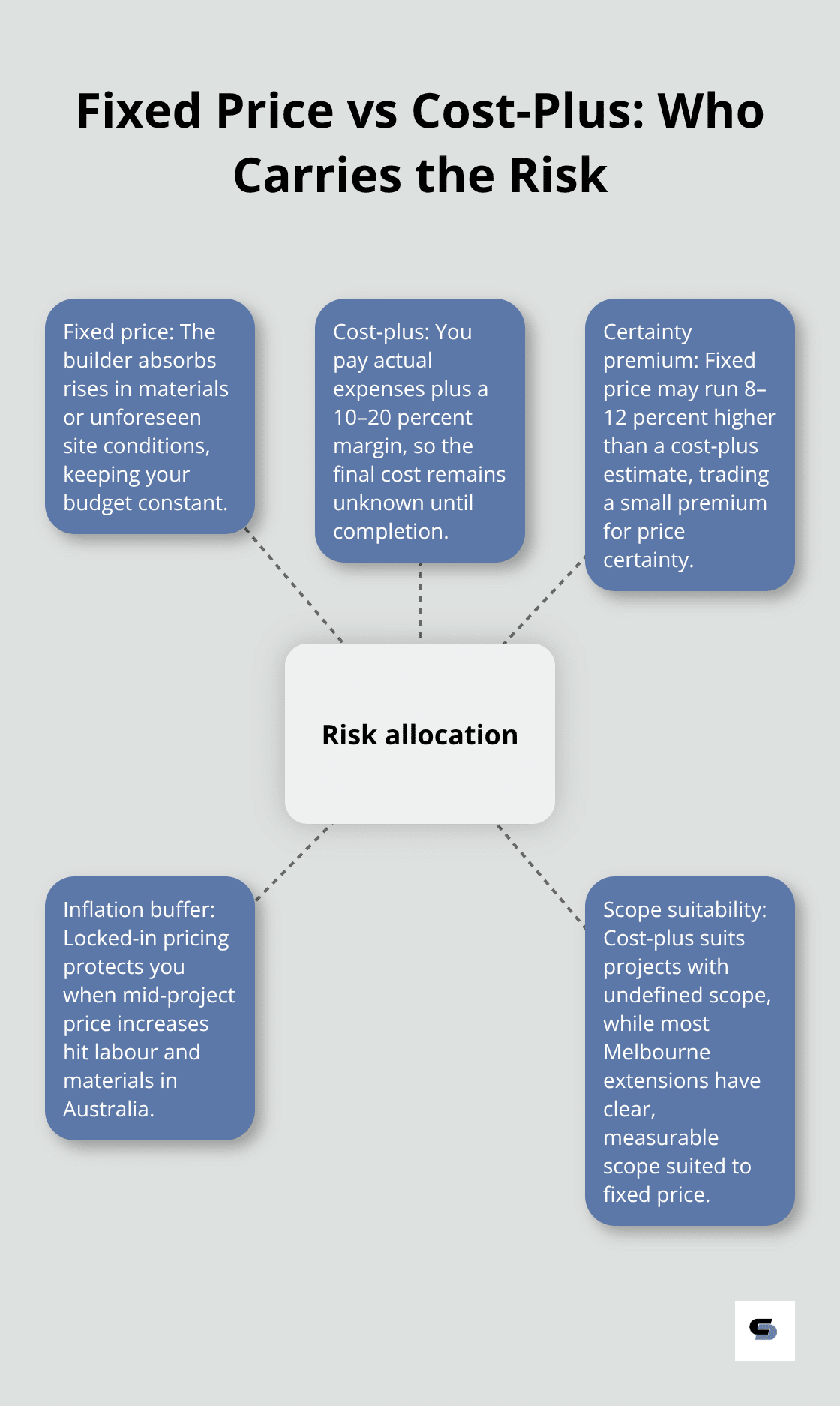
This differs fundamentally from cost-plus arrangements, where you pay actual expenses plus a margin, leaving the final bill unknown until the project ends. The Victorian Building Contracts Act 1995 permits cost-plus only for projects worth $1 million or more, which signals something important: for most Melbourne home extensions, fixed price represents the standard protection homeowners deserve.
How Detailed Scope Determines Price Accuracy
The quality of your fixed price depends entirely on how detailed your scope of works is before signing. A vague specification invites disputes because the builder’s quote and your expectations rarely align when left unspoken. Your contract must list exact materials, finishes, appliances, colour schemes, and whether items like kitchen cabinetry or bathroom fixtures come from you or the builder. Plasterboard finish levels matter too-level 3, 4, or 5 finishes cost differently and look different on visible surfaces. Consumer Affairs Victoria emphasises that detailed plans finished before construction starts prevent cost blowouts. Provisional sums and prime cost items undermine fixed pricing; if your quote includes these, you lack true protection because costs can shift later. Request that the builder specify makes, models, and prices for all allowances. This transforms a quote from guesswork into a genuine fixed price.
Why Fixed Price Outperforms Cost-Plus Risk
Cost-plus contracts place financial risk on you. The builder charges a percentage markup-typically 10–20 percent-over whatever they actually spend, meaning you won’t know the final cost until the project concludes. This model suits projects where scope cannot be defined upfront, but most Melbourne extensions have clear, measurable scope. Fixed price shifts risk to the builder, which is why they price higher to account for contingencies. A fixed price quote might run 8–12 percent more than a cost-plus estimate for the same work, but that premium buys certainty. Construction costs in Australia have risen significantly, which makes locked-in pricing increasingly valuable. When inflation hits mid-project, a fixed price protects your budget while a cost-plus arrangement leaves you exposed to every price movement in labour and materials.
What Happens When You Request Multiple Quotes
Comparing fixed price quotes from different builders reveals how scope interpretation affects cost. Two builders may quote the same extension at vastly different prices because they specify different materials, finishes, or construction methods. Request that each builder provide identical scope documents so you can compare apples to apples. Ask each builder to identify what they’ve included and excluded-this transparency shows which builder understands your project and which one has missed details. A suspiciously low quote often signals that the builder has underestimated scope or plans to charge variations later. Conversely, a significantly higher quote might reflect premium materials or more conservative contingencies. The builder who takes time to understand your site conditions, soil reports, and design intent typically produces the most accurate fixed price.
Your next step involves understanding which costs Melbourne councils and suburbs impose on extensions, and how these fees factor into your overall budget.
Common Costs in Melbourne Extension Projects
Labour and Material Expenses Shape Your Budget
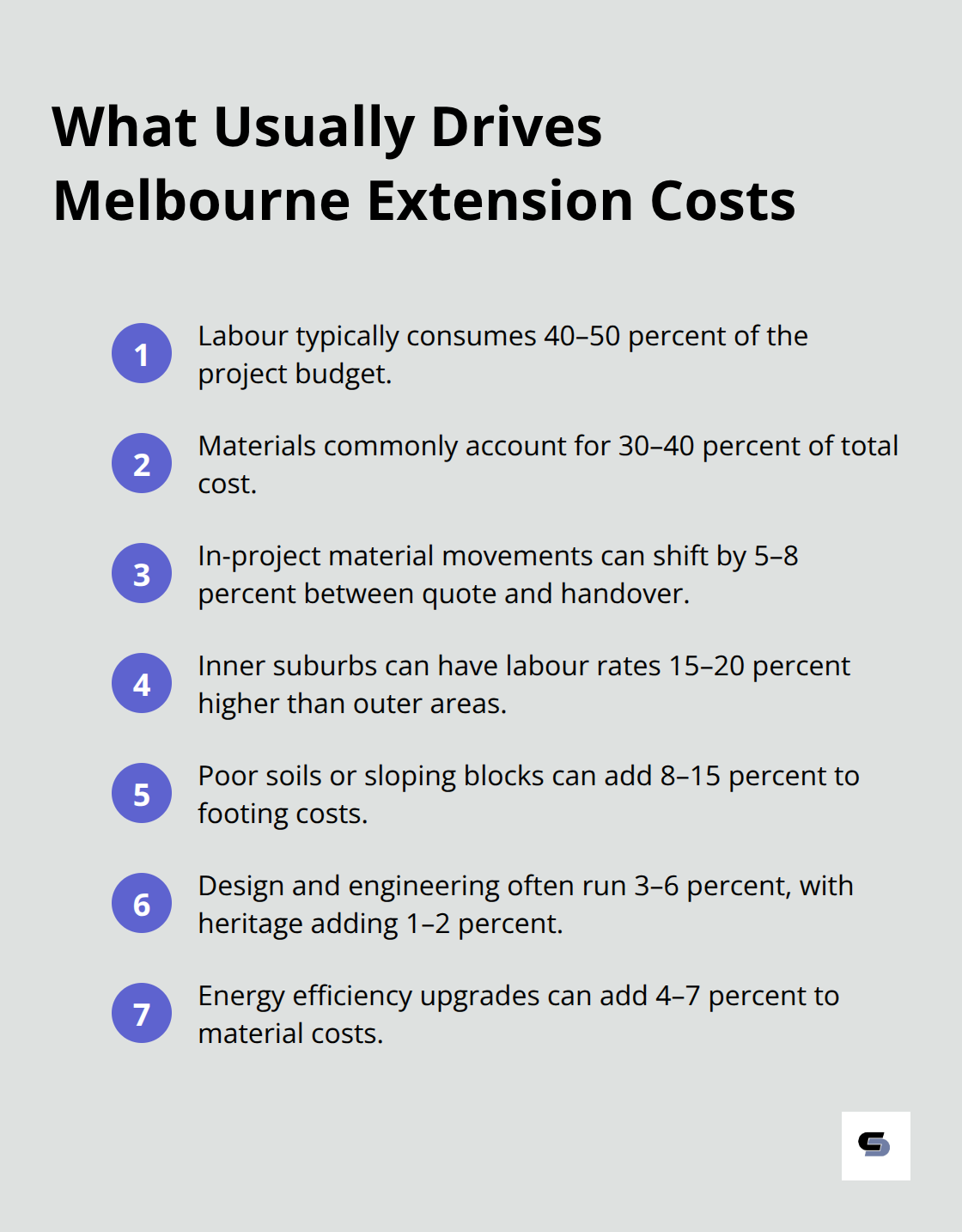
Labour dominates extension budgets, typically consuming 40–50 percent of total project cost, with skilled tradespeople commanding premium rates in Melbourne’s competitive market. Material expenses follow closely, representing 30–40 percent, though price volatility matters significantly-building construction prices have risen since 2021, according to industry data. Material price movements within a single project can shift by 5–8 percent between quote and handover, which is precisely why fixed price contracts protect homeowners by locking these costs upfront. Labour rates vary substantially across Melbourne suburbs; inner suburbs like Fitzroy and South Yarra command higher hourly rates than outer areas, sometimes differing by 15–20 percent for the same trade.
Site Conditions and Foundation Costs
Soil conditions drive costs unpredictably-sloping block extensions or sites with poor soil bearing capacity require deeper, more expensive footings, adding 8–15 percent to foundation costs. You need soil reports and foundation data before accurate pricing becomes possible; the builder must obtain these to design footings properly and provide realistic cost estimates. Design and engineering costs typically run 3–6 percent of total project value for extensions, though heritage properties in Melbourne often require specialist heritage consultants, adding another 1–2 percent.
Permits, Fees, and Compliance Requirements
Planning permits and building permits represent separate line items that many homeowners underestimate; planning permit applications through the City of Melbourne or relevant council usually cost $500–$2,000 depending on project complexity and zone classification, while building permits add another $1,000–$3,000. Council fees and statutory charges vary significantly across Melbourne suburbs. Some councils impose infrastructure levies on extensions, particularly in growth corridors, adding $2,000–$8,000 to larger projects. Heritage overlays trigger stricter permit requirements and longer approval timelines, which delays construction and extends project duration. Waste management and skip bin permits on public land require separate approvals and fees through your local council, typically $200–$600.
Energy efficiency standards under the Building Code of Australia influence material selection and labour intensity, particularly for insulation and window specifications, which can add 4–7 percent to material costs compared to minimum compliance. Accessibility requirements in some renovation scopes add cost; if your extension includes wet areas or staircases, compliance with disability standards may require premium fixtures or construction methods.
Comparing Quotes to Reveal True Costs
Most Melbourne homeowners benefit from obtaining at least three written quotes and comparing them side-by-side, specifying identical scope documents so cost differences reflect genuine builder variation rather than scope interpretation gaps. Fixed price quotes that exclude provisional sums and prime cost items give you the clearest picture of what Melbourne extension projects actually cost in your specific location and circumstances. A suspiciously low quote often signals that the builder has underestimated scope or plans to charge variations later. Conversely, a significantly higher quote might reflect premium materials or more conservative contingencies. The builder who takes time to understand your site conditions, soil reports, and design intent typically produces the most accurate fixed price.
Understanding these costs across Melbourne’s diverse suburbs and zones positions you to identify which builder has priced your project realistically-and which one has missed critical details that will surface as variations later.
Protect Your Budget with Precise Specifications
The difference between a genuine fixed price and a quote that becomes a moving target lies entirely in how specifically you define what the builder will construct. Homeowners who spend two weeks nailing down every detail avoid cost blowouts, while those who hand a builder vague instructions face variations that destroy their budget. Start by requesting that each builder provide their quote using identical scope documents you’ve prepared together. This means the same floor plans, the same material specifications, the same finish levels for plasterboard and paint, and the same fixture models for kitchens and bathrooms.
Identical Scope Documents Reveal True Price Differences
When three builders quote from different scope interpretations, their prices tell you nothing useful because they’re pricing three different projects. Demand that each builder list what they’ve included and what they’ve explicitly excluded, then ask them to explain why certain items are missing compared to competitors. A builder who glosses over these details or resists providing written clarification signals that they’ll charge variations later when scope gaps emerge. Consumer Affairs Victoria emphasises that provisional sums and prime cost items destroy fixed pricing because they’re placeholders for costs to be determined later, which means your quote isn’t actually fixed at all. If a builder includes these, push back hard and insist they specify exact makes, models, and prices instead. The builder’s willingness to commit to specific product choices rather than hiding behind allowances reveals whether they’ve genuinely understood your project or are simply protecting themselves against scope creep.
Labour Rates and Material Choices Drive Real Costs
Once you’ve gathered quotes with identical scope documents, compare the labour rates and material choices each builder has embedded in their pricing. Labour typically consumes 40–50 percent of extension budgets, so differences in quoted rates signal either genuine market variation across Melbourne suburbs or quality differences in the tradespeople they’ll deploy. Inner suburbs like Fitzroy command 15–20 percent higher rates than outer areas for identical trades, which is legitimate, but a builder quoting significantly higher labour rates than competitors while using identical scope suggests either premium credentials you should verify or inflated contingencies. Material costs matter equally because a builder specifying premium insulation or heritage-compliant windows will price higher than one choosing basic compliance-level alternatives, and that difference should be transparent in your scope documents.
Breaking Down Quotes Line-by-Line
Request that each builder break down their quote into labour, materials, permits, design, and contingency, then compare line-by-line rather than looking only at the total. A suspiciously low total often masks underestimated labour, missing design costs, or incomplete permit allowances that will surface as variations. The builder who invests time understanding your site conditions, soil reports, and design intent produces the most accurate fixed price because they’ve identified genuine risks upfront rather than hiding them in contingencies or variations later. A builder who resists providing this breakdown or offers only a single-line total price hasn’t done the work necessary to protect your budget.
Final Thoughts
Fixed price extensions Melbourne eliminate the financial uncertainty that derails most renovation projects. When you lock in a price upfront with detailed scope documents, you gain genuine control over your budget from signing to handover. The builder absorbs cost increases from material price movements or unforeseen site conditions, which means your budget stays intact regardless of what emerges during construction.
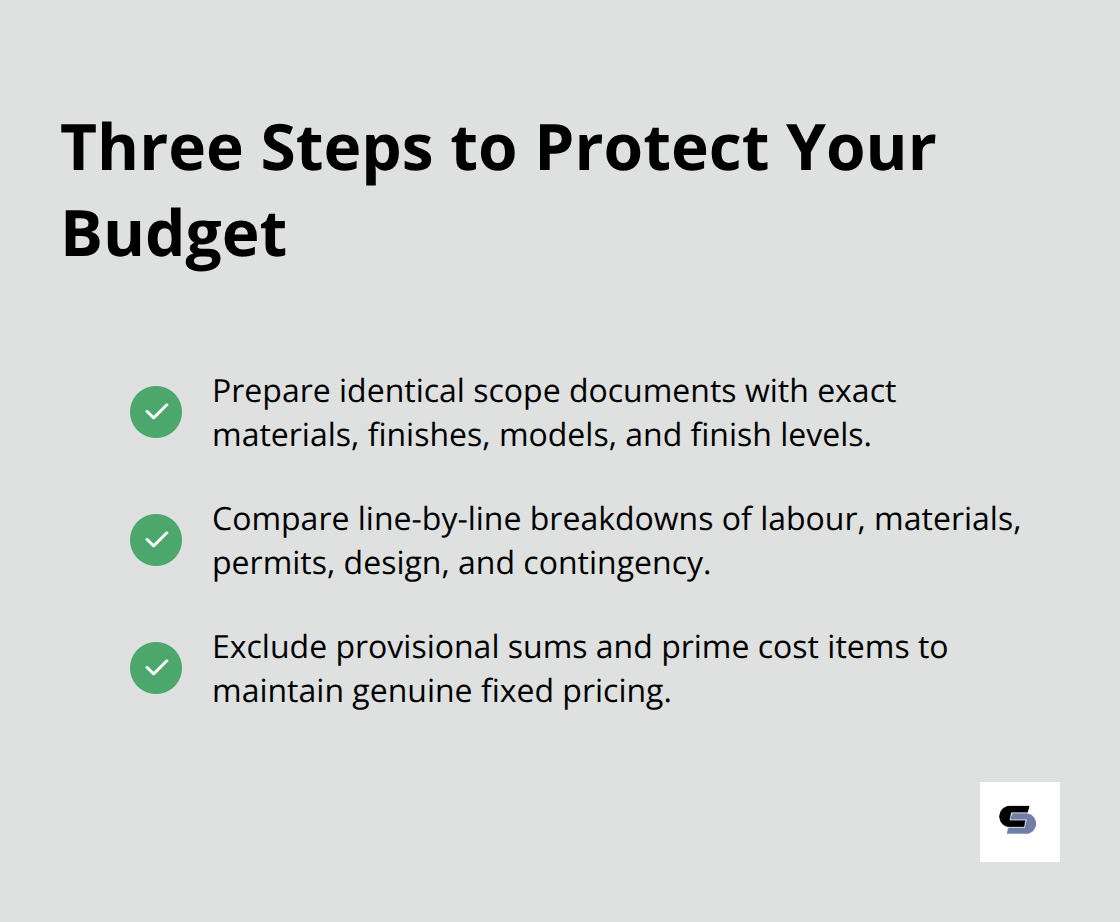
Protecting your budget requires three concrete steps. First, prepare identical scope documents that every builder quotes from, specifying exact materials, finishes, appliance models, and plasterboard levels so you compare genuine price differences rather than scope interpretation gaps. Second, request that each builder break down their quote into labour, materials, permits, design, and contingency, then compare line-by-line to identify which builder has priced realistically and which one has missed critical details. Third, verify that your fixed price excludes provisional sums and prime cost items, which are placeholders that destroy fixed pricing the moment construction starts.
Choosing the right builder matters more than the price itself because a builder who invests time understanding your site conditions, soil reports, and design intent produces accurate fixed pricing that protects your budget. A builder who resists providing detailed breakdowns or offers only a single-line total hasn’t done the work necessary to prevent variations later. When you’re ready to discuss fixed price extensions Melbourne, contact Cameron Construction to receive a detailed quote built on transparent, realistic scope definition.