Cost-Effective Kitchen Upgrades for Your Melbourne Home
Your kitchen doesn’t need a complete overhaul to feel fresh and functional. At Cameron Construction, we’ve helped Melbourne homeowners transform their kitchens with cost-effective upgrades that genuinely improve daily life.
The right changes-from new benchtops to better lighting-deliver real value without breaking the budget. This guide shows you exactly where to invest and what mistakes to avoid.
Plan Before You Spend
Most Melbourne homeowners who regret their kitchen upgrades skip the planning stage. We see this repeatedly-people rush into selections without understanding what actually needs fixing or what their home can support. Walk through your kitchen at different times of day. Notice where you struggle: Does the bench feel cramped when cooking? Do you lack storage? Is lighting poor near the sink? These observations matter far more than trend magazines. Your kitchen’s weak points should drive your spending decisions, not Instagram inspiration.
Assess your kitchen’s actual problems
Document your kitchen’s current problems in writing. Take photos of storage issues, lighting gaps, and worn surfaces from multiple angles. If you’re considering appliance upgrades, check whether your existing electrical circuits can handle them-this is where most budget surprises emerge. A standard kitchen circuit handles about 20 amps, but modern induction cooktops demand dedicated circuits, often requiring an electrician’s assessment at $200–$400. Similarly, plumbing changes cost significantly more than surface updates. If your current layout requires moving a sink or adding a new benchtop with different dimensions, factor in $1,500–$3,000 for plumbing work.
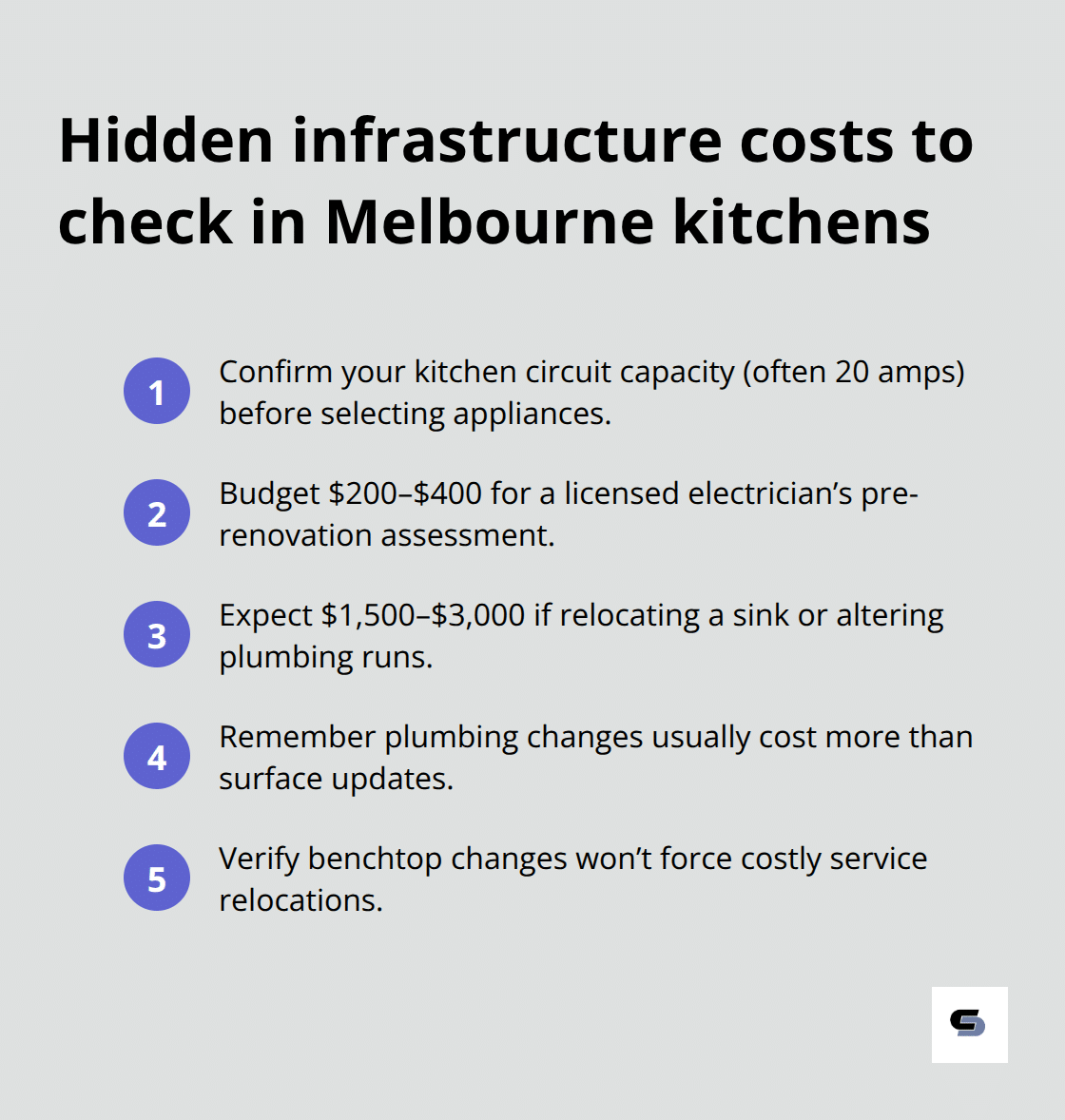
Understanding these hidden costs before budgeting prevents the common mistake of allocating money to aesthetics when infrastructure work is actually needed.
Know your budget threshold
For projects exceeding $10,000, Consumer Affairs Victoria requires a written major domestic building contract with a registered builder. Confirm whether your plans cross this threshold early. Research actual material costs in your area rather than guessing. Benchtops range from $150–$300 per linear metre for laminate to $500–$1,200 for stone, and splashbacks add another $50–$150 per square metre depending on material. Cabinetry refacing costs $3,000–$8,000 for an average kitchen, while new bespoke cabinetry runs $8,000–$20,000 or more.
Rank changes by impact and necessity
Once you know material costs, rank changes by impact and necessity. Prioritise functional improvements-better lighting, increased storage, and updated appliances-over purely cosmetic changes. A kitchen with excellent storage and lighting but dated finishes outperforms a visually trendy kitchen that lacks functionality. Energy-efficient appliances deliver ongoing savings through the Victorian Energy Upgrades program. These functional priorities form the foundation for the high-impact upgrades that actually transform how you use your kitchen daily.
Where Your Kitchen Budget Delivers the Most Value
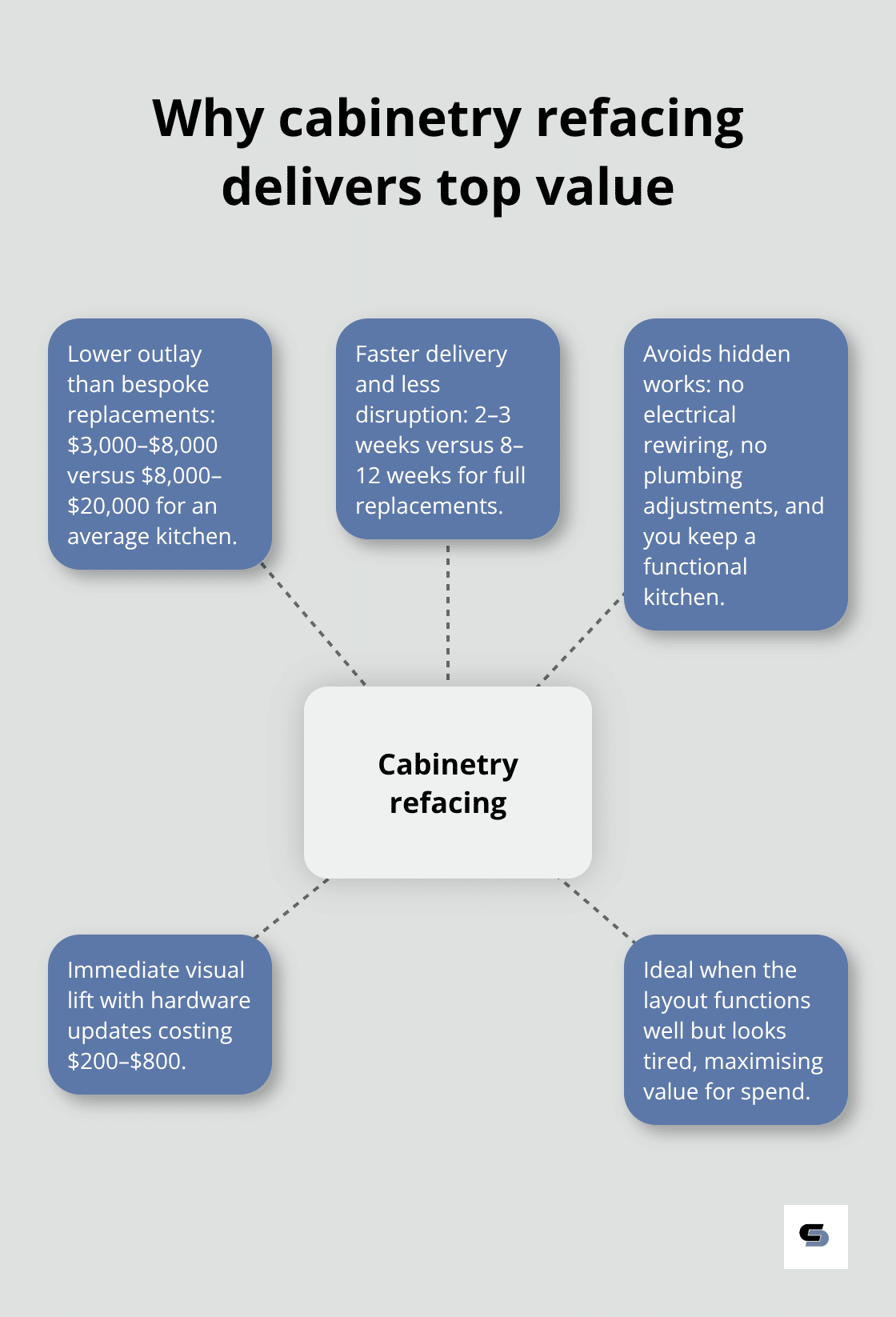
Cabinetry refacing stands out as the single most cost-effective upgrade for Melbourne kitchens, delivering transformation at a fraction of new cabinetry costs. Refacing runs $3,000–$8,000 for an average kitchen, compared to $8,000–$20,000 for bespoke replacements. The process involves keeping your existing cabinet structure and replacing doors, drawer fronts, and hardware while refinishing exposed frames. This approach works particularly well if your current layout functions well but looks tired. New hardware alone-upgraded handles, knobs, and hinges-costs $200–$800 and creates immediate visual impact without structural work. Melbourne homeowners often underestimate hardware’s effect; changing from dated chrome to brushed brass or matte black transforms perception at minimal cost. Refacing also avoids the hidden expenses of new cabinetry: no electrical rewiring for appliances, no plumbing adjustments, and no days without a functional kitchen. The work typically completes in 2–3 weeks, whereas full cabinetry replacement stretches to 8–12 weeks with potential delays in manufacturing and installation.
Benchtops and splashbacks shape daily functionality
Benchtop and splashback replacements deliver visible results and improved durability. Stone benchtops-granite, marble, or engineered stone-cost $500–$1,200 per linear metre installed and offer 15–20 year lifespans with proper sealing. Laminate alternatives run $150–$300 per linear metre but require replacement every 7–10 years as edge wear and moisture damage accumulate. For most Melbourne homeowners on a moderate budget, engineered stone provides the best balance: it costs less than natural stone, resists staining better than laminate, and lasts significantly longer. Splashbacks ($50–$150 per square metre) protect walls and define visual character. Ceramic tiles remain the most durable choice, though glass and stainless steel offer modern aesthetics. The critical decision involves coordinating materials: a stone benchtop paired with subway tile splashback creates timeless appeal, whereas trendy material combinations (patterned tiles with marble, for example) risk looking dated within five years.
Strategic lighting and storage transform usability
Lighting directly impacts how usable your kitchen feels during daily cooking and cleaning. Under-bench lighting ($200–$600 installed) eliminates shadows on work surfaces and costs far less than relocating overhead fixtures. LED strips last 25,000–50,000 hours and consume minimal power compared to older halogen systems. Storage solutions often matter more than aesthetics: pull-out pantries, corner carousels, and vertical dividers cost $300–$1,500 per installation but recover that investment through reduced food waste and faster meal preparation. Melbourne kitchens built before 2000 typically lack adequate storage, forcing homeowners to compensate with bench clutter. Adding shelving above benches ($150–$400) or installing tall pantry units ($1,000–$3,000) addresses this directly. Kitchens with excellent storage and functional lighting consistently outperform visually trendy kitchens lacking these features. Prioritise what you actually use daily over what photographs well.
Energy-efficient appliances reduce ongoing costs
Upgrading to energy-efficient appliances delivers both immediate functionality and long-term savings. Induction cooktops operate approximately three times more efficiently than gas, reducing energy bills and emissions significantly. The Victorian Energy Upgrades program offers incentives that lower upfront costs for eligible Victorian households. Energy Star-rated refrigerators and freezers consume substantially less power than older models, and high-efficiency hot water systems save up to $330 annually on energy bills. These upgrades align with your kitchen’s functional priorities and qualify for government support, making them genuinely cost-effective investments rather than optional luxuries. Your kitchen upgrade now connects to broader home efficiency improvements that protect your investment over time.
Avoiding Common Mistakes in Kitchen Renovations
Infrastructure work derails most kitchen budgets
Infrastructure costs sink most kitchen upgrades before work even starts. You plan a $15,000 project and discover your electrical panel cannot support an induction cooktop without a $2,500 upgrade, or your plumbing sits behind walls requiring $3,000 in rerouting. Homeowners typically allocate 80% of their budget to visible changes, then face infrastructure costs that force painful compromises. Have a licensed electrician inspect your kitchen’s current capacity before finalising your material selections. Standard kitchen circuits operate at 20 amps, but induction cooktops require dedicated circuits. Modern dishwashers require separate circuits from your cooktop. If your home was built before 1990, your panel likely cannot accommodate these additions without upgrade work. A pre-renovation electrical assessment costs $200–$400 and prevents the shock of discovering mid-project that your chosen appliances cannot function safely.
Plumbing surprises accumulate quickly and drain budgets rapidly. Relocating a sink adds $1,500–$3,000 in labour and materials. Adding a second tap or moving benchtops that affect water supply lines costs $800–$2,000. Request a plumbing inspection alongside your electrical assessment. Document your existing pipe locations and sizes so your builder can provide accurate quotes. Consumer Affairs Victoria requires that projects exceeding $10,000 use a registered builder under a written major domestic building contract, and this protection becomes essential when hidden infrastructure work emerges. Your contract should specify which party obtains permits and handles inspections-typically your builder manages this, but confirm in writing to avoid responsibility gaps.
Timeless design outlasts trend cycles
Design trends fade faster than your kitchen’s infrastructure lasts. Avoid chasing current aesthetics when selecting materials and finishes. Patterned tiles that feel fresh today look dated within five years; neutral subway tiles remain functional and visually acceptable across decades. Stone benchtops in classic colours (greys, whites, blacks) outlast trendy patterns significantly. Hardware trends shift constantly-rose gold gave way to brushed brass, which now competes with matte black. Select finishes in neutral metallics and colours that complement your home’s existing palette rather than trend forecasts. Your kitchen will function for 15–20 years, but design trends cycle every 3–5 years. A timeless kitchen with excellent storage and lighting consistently outperforms a visually trendy kitchen lacking functionality.
Project timelines require honest planning
Project timelines stretch far longer than most homeowners anticipate. New cabinetry typically requires 8–12 weeks from order to installation, and this assumes no manufacturing delays. Benchtop fabrication adds 2–4 weeks. Electrical and plumbing work stretches timelines further if your builder uncovers issues during construction.
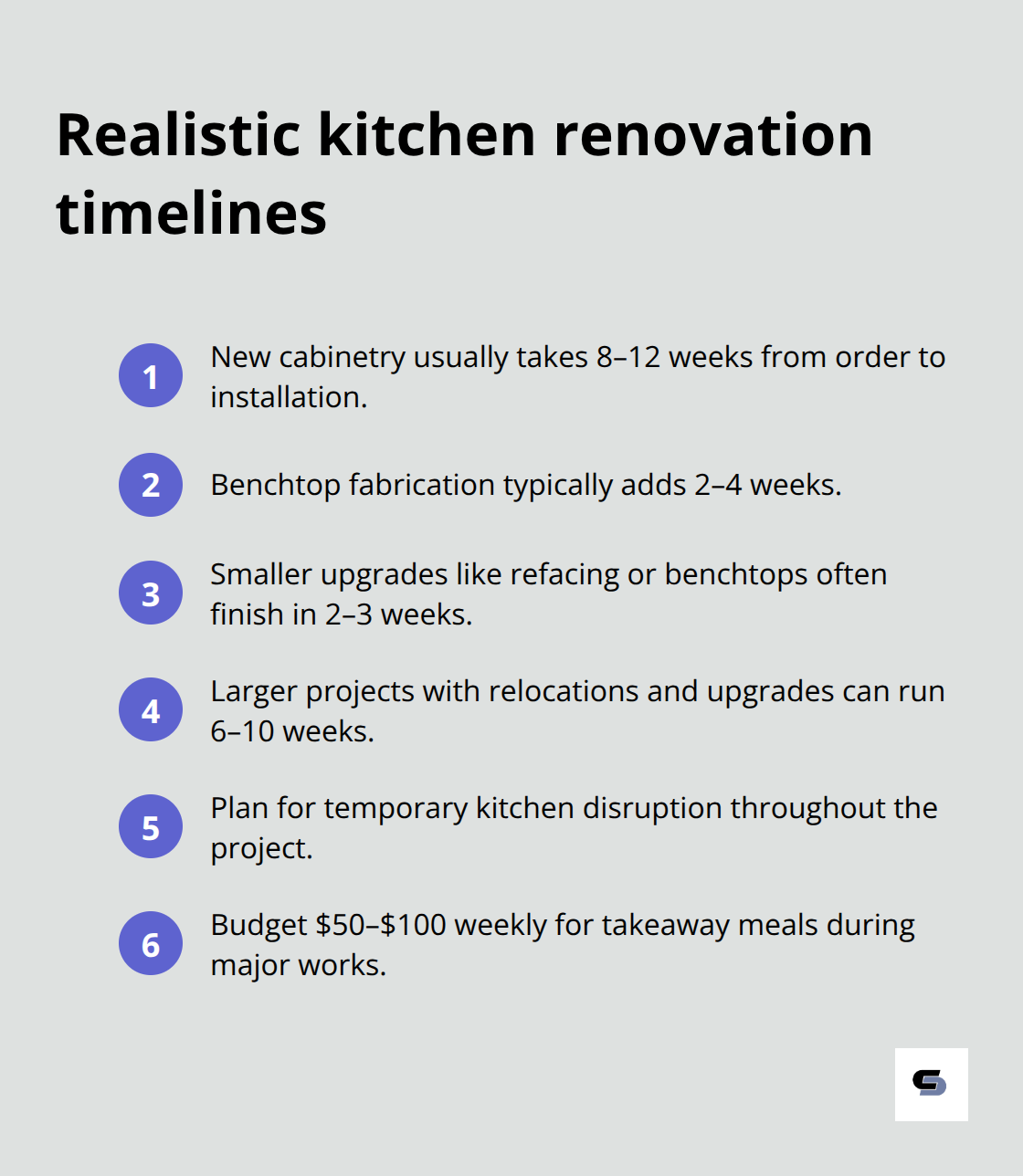
Most Melbourne homeowners underestimate disruption: your kitchen becomes partially or fully unusable during the project. If you use your kitchen for meal preparation daily, plan for takeaway costs and temporary workspace arrangements. Budget $50–$100 weekly for meal expenses during major renovation work.
Smaller upgrades compress timelines significantly. Cabinet refacing or benchtop replacement only takes 2–3 weeks and minimises disruption. Larger projects involving appliance relocation, electrical upgrades, or structural changes extend to 6–10 weeks. Communicate your actual timeline expectations with your builder before signing the contract. Vague timelines create tension when work stretches beyond assumptions.
Final Thoughts
Cost-effective kitchen upgrades for Melbourne homes succeed when you prioritise function over trends and plan infrastructure before selecting finishes. The upgrades that deliver genuine value-improved storage, strategic lighting, durable benchtops, and energy-effective appliances-transform how you use your kitchen daily while protecting your investment across 15–20 years. A pre-renovation assessment from licensed trades costs $200–$400 and prevents budget-draining surprises that emerge mid-project.
Your next step involves documenting your kitchen’s actual problems rather than aesthetic preferences. Walk through at different times, photograph problem areas, and list what genuinely frustrates you during daily use. This clarity drives smarter spending decisions than trend magazines or social media inspiration, and once you understand your kitchen’s weaknesses, obtain quotes from registered builders who can assess infrastructure needs and provide accurate timelines. For projects exceeding $10,000, Consumer Affairs Victoria requires a written major domestic building contract with a registered builder-this protection becomes essential when hidden costs emerge.
Professional guidance protects your investment by catching infrastructure issues early, preventing timeline blowouts, and ensuring your selections align with your home’s actual capacity. Contact Cameron Construction to discuss your cost-effective kitchen upgrades Melbourne project, and our in-house designers, engineers, and project managers will manage the complexity that derails most kitchen upgrades, coordinating electrical, plumbing, and structural work alongside your material selections. Start your upgrade by scheduling assessments with licensed electricians and plumbers, then connect with builders who understand Melbourne’s specific requirements and can deliver realistic timelines and costs.