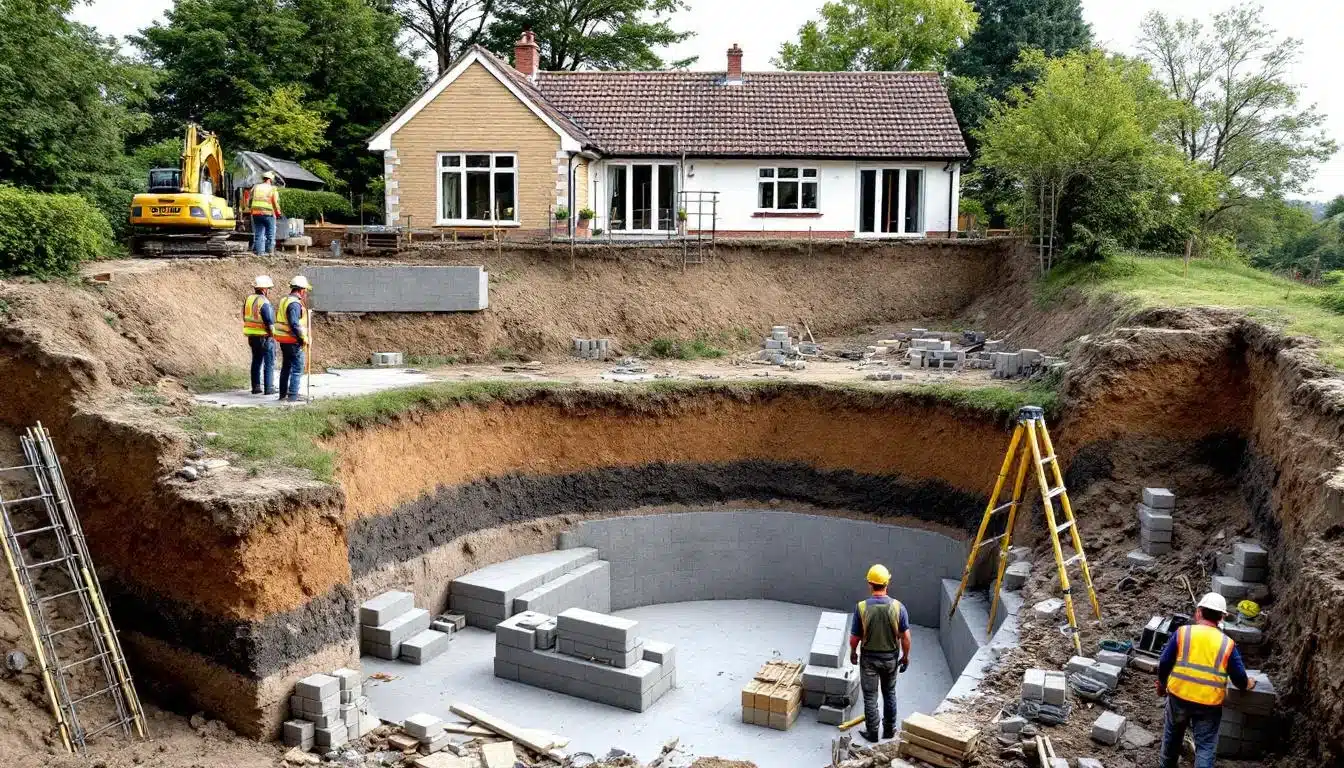
Why Sloping Block Extensions Require Specialist Builders
Sloping block extensions demand far more than standard building practices. At Cameron Construction, we’ve seen too many homeowners struggle because they hired builders without experience on difficult terrain.
Melbourne’s sloped blocks present real engineering challenges that most general contractors simply aren’t equipped to handle. Getting this right from the start saves you money, time, and headaches down the track.
What Makes Sloping Blocks Structurally Different
Slope Gradient and Foundation Choices
Slope gradient is the first problem most builders underestimate. A slope steeper than 1:14 means the ground rises or falls more than 700 millimetres over every 10 metres horizontally. This gradient directly determines your foundation type, and getting it wrong costs tens of thousands in rework. Stepped footings work on moderate slopes, but steep sites need piers or suspended slabs that cost significantly more upfront. A structural engineer must assess your specific slope angle, soil bearing capacity, and groundwater conditions before any design happens. This assessment isn’t optional-it forms the foundation of everything that follows.
Retaining Walls and Soil Pressure
Retaining walls compound the complexity because they hold back soil that wants to move downhill. If you’re building on a slope, you’re almost certainly adding retaining walls, and these structures fail when drainage is poor or design underestimates soil pressure. A specialist must design the wall to prevent cracking, tilting, or collapse. South Australian law-which applies similar principles across Australian jurisdictions-holds the landowner liable for damage caused by altered ground, meaning if your retaining wall fails and damages a neighbour’s property, you pay. That’s why geotechnical testing and engineer-designed walls aren’t luxuries; they’re legal and financial necessities.
Building Code Relief on Slopes
Building Code compliance on slopes introduces another layer. The National Construction Code requires step-free paths from your property boundary to the dwelling entry, but sloping blocks get relief: if your average ground slope exceeds 1:14, you may have no obligation to provide that boundary-to-entry path at all. You can use your garage as the designated entry point, which changes your whole design strategy. Corridor widths and door openings (typically 820 millimetres for key doors) still apply, but the slope concession gives you flexibility.
Melbourne Council Height and Setback Rules
Melbourne council permits are stricter on slopes because height limits change based on terrain. If your cross-section slope is 2.5 degrees or steeper across an 8-metre width, you can build taller, but side and rear setbacks increase proportionally-for every metre above 3.6 metres, you need an extra 300 millimetres of setback. Boundary walls face length limits too: you can build up to 10 metres plus 25 percent of your remaining boundary length, but only if the effective wall height stays below 2 metres.
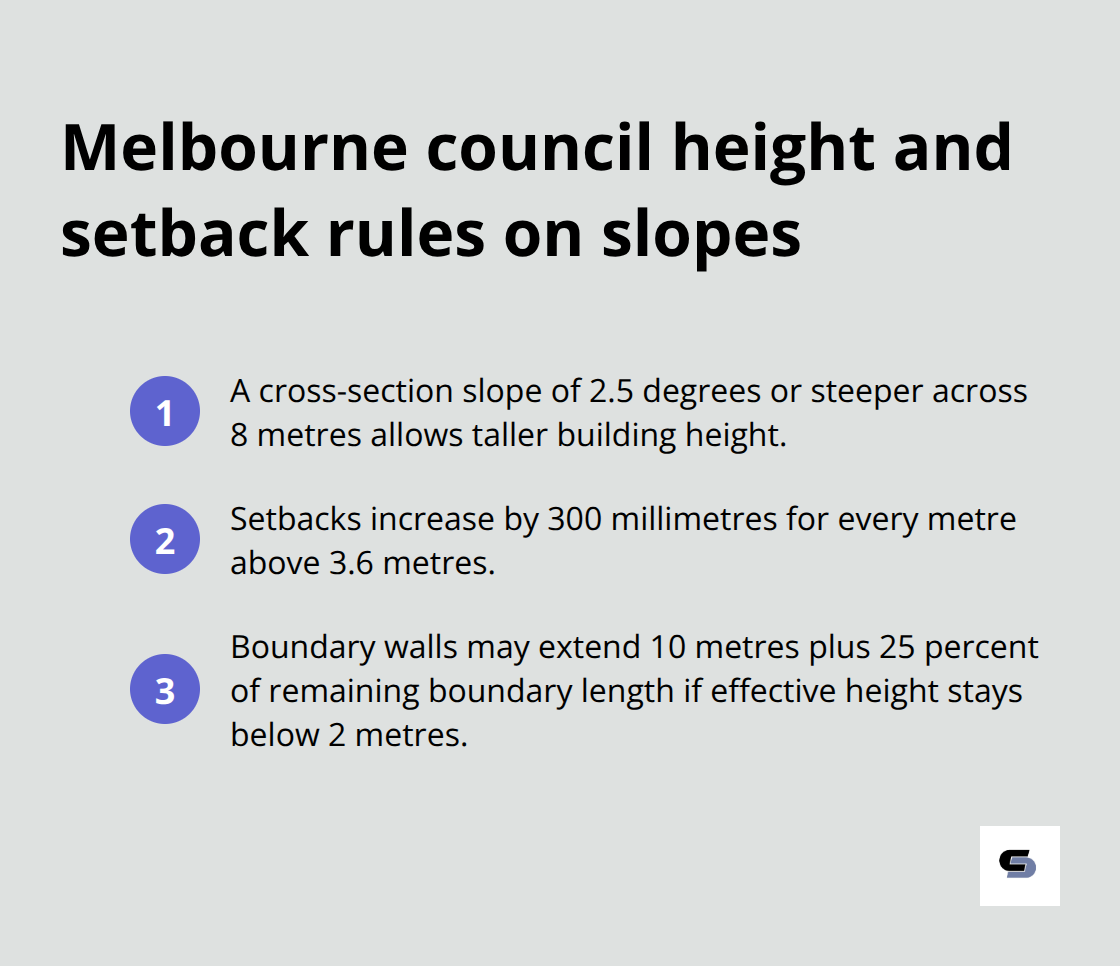
Exceed that, and setbacks apply, which shrinks your usable footprint. These rules vary slightly between councils, and specialist builders know which Melbourne councils enforce these rules strictly and which offer flexibility through planning overlays or design excellence pathways. Understanding these local variations shapes whether your extension fits the site or requires costly redesign.
Structural Solutions That Work on Sloping Terrain
Sloping blocks force you to abandon standard building methods and adopt designs that work with the terrain rather than against it. Three structural approaches deliver on slopes: elevated foundations that sit on piers or pilotis, terraced designs that step down the slope, and integrated drainage systems that prevent the ground from destabilising your extension.
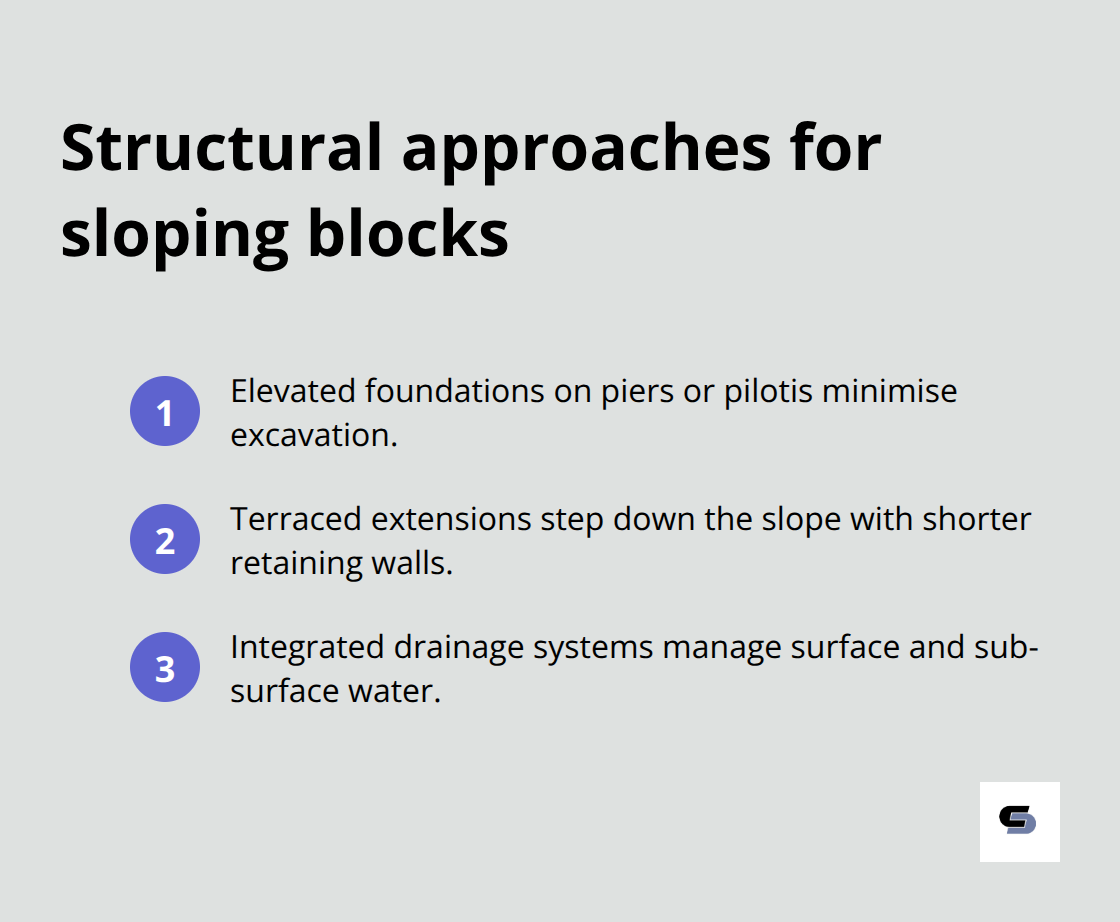
Each approach carries real cost and timeline implications that shape your project budget and schedule.
Piloti and Elevated Slab Design
Piloti structures-essentially raising your building on columns or piers-work exceptionally well on steep slopes because they minimise excavation and preserve the slope’s natural stability. Instead of cutting into the hillside and building retaining walls, structural columns transfer loads deep into stable soil. A geotechnical engineer calculates the soil bearing capacity at depth, then the structural engineer sizes the piers accordingly. On a typical Melbourne slope, piers extend 1.5 to 3 metres below the surface to reach competent soil, and this depth directly affects cost. Shallow piers cost less but only work on moderate slopes; deep piers cost more but handle steep terrain safely. Suspended concrete slabs above the piers create your floor level, and this approach offers flexibility: you can position the slab to create usable space underneath (covered outdoor areas, storage, or parking) or leave it open to preserve the slope. Exposed concrete floors stabilise indoor temperatures effectively, but on slopes you pay a premium for the structural engineering and pile installation. This method reduces retaining wall requirements significantly, which cuts long-term maintenance headaches and neighbour disputes over wall repairs.
Terracing and Stepped Designs
Terraced extensions step down the slope in stages rather than building one large mass that requires massive retaining structures. Each terrace level sits on a shorter, more manageable retaining wall, and the stepped profile complies more easily with Melbourne council setback and height rules. When wall heights stay below 2 metres per stage, you avoid the steeper setback penalties that apply to taller walls. A practical example: a 6-metre-high extension on a slope might be designed as two 3-metre terraces instead of one solid mass. The lower terrace sits further down the slope with a modest retaining wall, and the upper terrace steps back, creating a visual break and reducing the perceived bulk. Council planning approval typically moves faster for stepped designs because they demonstrate consideration for neighbour amenity and landscape integration. Terracing also simplifies drainage-each terrace level can have its own drainage zone, preventing water from accumulating behind a single massive wall. The trade-off is that stepped designs require more sophisticated structural connection between levels and more detailed engineering at the step transitions. Tie-ins between old and new structures become critical here; you cannot simply bolt new terraces to existing footings without assessing potential movement and reinforcing as needed.
Drainage Systems That Prevent Failure
Drainage is non-negotiable on sloping blocks, and most builders treat it as an afterthought. Water pressure behind retaining walls causes them to crack, lean, or fail catastrophically. Sub-surface drainage-perforated pipes laid behind walls with gravel and geotextile-must direct water away from the structure and toward natural drainage paths or stormwater systems. On slopes, you install not just one drainage line but multiple levels of drainage, each intercepting water before it reaches critical zones. Surface water management matters equally: roof runoff, gutter flows, and site grading must direct water away from your extension and toward street drainage or designated outfalls. If you add a second storey or extend downslope, the original drainage network may not handle the increased load. You need to assess whether the existing stormwater system has capacity or whether you create a drainage conflict that damages your property or your neighbours’. A licensed drainage engineer calculates runoff volumes based on roof area and slope gradient, then specifies pipe sizes and gradients to handle peak flows. On a typical Melbourne block with 150 square metres of new roof area, stormwater runoff during heavy rain can exceed 100 litres per second; undersized drainage pipes back up water into your extension, causing flooding and foundation damage. Specialist builders know this and budget for dedicated drainage design as a separate cost line, not as part of the general excavation works.
Why Specialist Engineering Matters on Slopes
Each of these structural solutions requires licensed engineers to design and certify the works. A structural engineer must calculate load paths, foundation depths, and connection details; a geotechnical engineer must assess soil conditions and slope stability; a drainage engineer must size pipes and specify gradients.
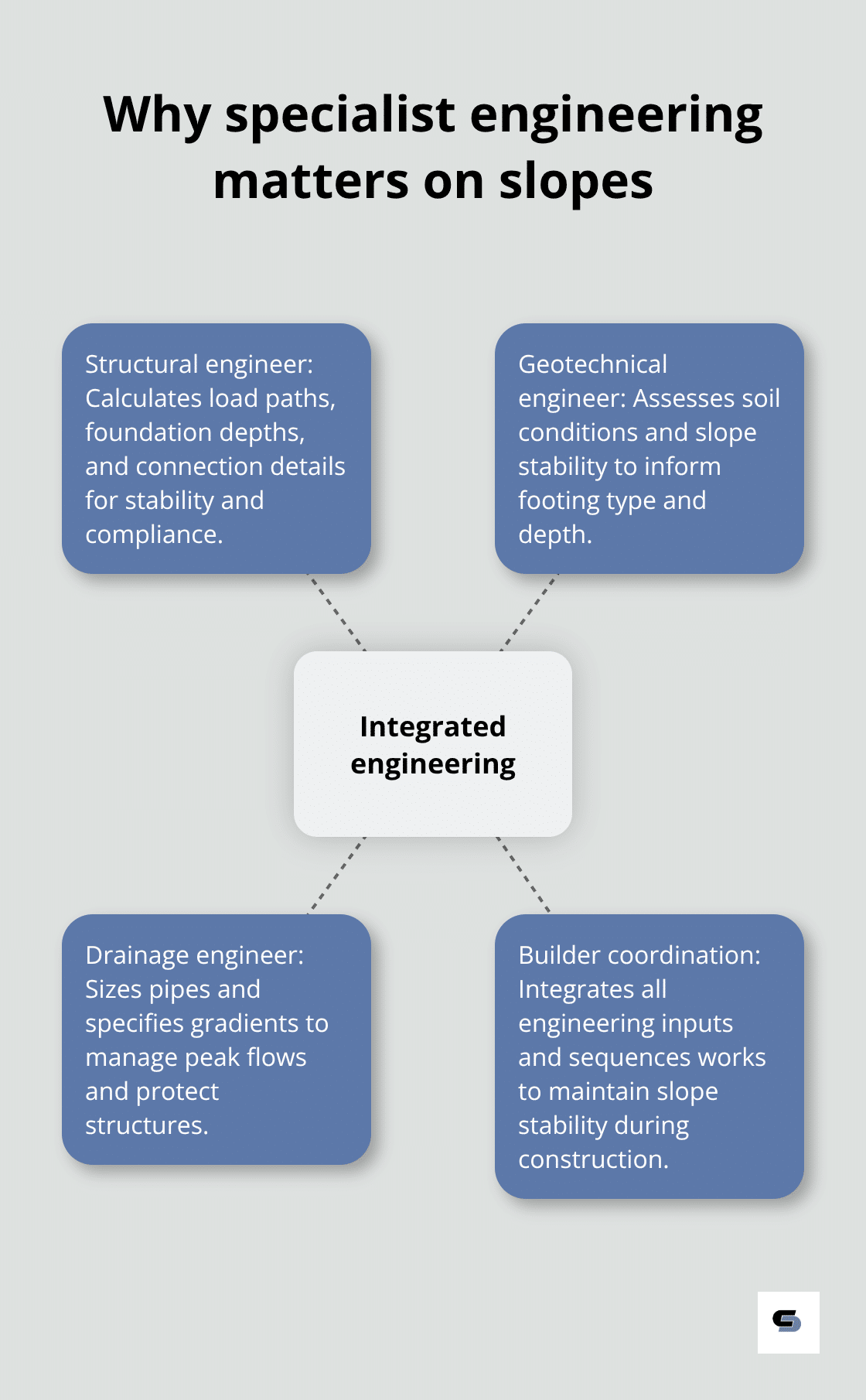
General builders often underestimate these costs or skip proper engineering altogether, which creates liability and failure risk. When you engage a builder with genuine experience on sloping blocks, they coordinate these specialists from the start, integrate their findings into the design, and manage the construction sequencing to maintain slope stability throughout the build. This coordination prevents costly rework and protects you legally if issues arise later.
What Separates Experienced Builders from General Contractors on Slopes
Site Analysis Sets the Project Foundation
Specialist builders treat site analysis as the foundation of the entire project, not as a box to tick. When assessing a sloping block, experienced builders commission geotechnical testing before design begins, not after, because soil conditions determine whether your extension needs piers at 2 metres depth or 4 metres depth-a difference that shifts costs by $50,000 or more. A general contractor typically relies on visual inspection and assumes standard footings will work, then discovers mid-construction that soil bearing capacity is inadequate or groundwater sits higher than expected. This discovery forces design changes, delays, and budget blowouts that specialist builders avoid entirely.
Melbourne Council Knowledge Accelerates Approvals
Melbourne councils impose different requirements depending on which suburb you’re building in and which planning overlays affect your property. Planning Practice Note 27 sets the baseline for residential development, but individual council schedules modify height limits, setbacks, and permeability requirements. A builder without deep Melbourne council experience treats all councils the same way, submitting designs that trigger rejections or require expensive modifications. Specialist builders maintain relationships with planning officers in each council, understand which design approaches move through approval quickly and which ones stall, and position your extension to satisfy local expectations on the first submission. This local knowledge cuts planning timelines from eight months to four months on average, which compresses your overall project schedule.
Terrain Experience Prevents Costly Surprises
Proven experience on difficult terrain means completing multiple extensions on sloping blocks in comparable soil conditions and slope angles. A builder with five years of experience might have completed one or two sloping block projects; a specialist with 40 years of delivery has completed dozens. That difference matters because each slope presents unique challenges-a block sloping north-south faces different drainage and retaining wall pressures than one sloping east-west, and a site with clay soil behaves completely differently from one with sand or rock. A specialist has seen these variations, knows which structural solutions work under which conditions, and anticipates problems before they surface.
Structural Tie-Ins Require Specialist Assessment
When tie-ins between new and existing structures occur on a slope, a specialist builder assesses potential movement and specifies reinforcement or bespoke detailing that protects your investment long-term. A general contractor often treats tie-ins as standard connections, which creates cracking and failure risk as the slope shifts or settles over time. This assessment prevents structural issues that emerge years after handover, when remedial work costs far more than proper design upfront.
References Reveal True Track Records
Ask any builder for three completed sloping block extensions in similar terrain, then contact those clients directly and ask about budget accuracy, timeline delivery, and whether drainage or structural issues emerged after handover. A builder unwilling to provide recent references or who cites projects more than five years old signals limited current experience. Specialist builders welcome reference cheques because their track record speaks for itself.
Final Thoughts
Sloping block extensions demand specialist expertise because soil conditions, drainage systems, retaining wall design, and Melbourne council compliance interact in ways that general contractors cannot safely manage. A builder without proven track record on difficult terrain will underestimate costs, miss planning requirements, or create structural problems that emerge years after handover. The financial and legal risks of cutting corners far outweigh the upfront savings of hiring an inexperienced contractor.
Professional builders deliver better outcomes because they treat site analysis as the foundation of the project, not an afterthought. They commission geotechnical testing before design begins, coordinate structural and drainage engineers from day one, and understand which Melbourne councils enforce setback and height rules strictly. They anticipate problems that general contractors discover mid-construction, when fixes become expensive and disruptive.
Finding a builder with genuine experience on comparable terrain in your Melbourne suburb means asking for three recent references from completed sloping block extensions and contacting those clients directly to ask about budget accuracy, timeline delivery, and whether drainage or structural issues emerged after handover. We at Cameron Construction have spent 40 years building extensions and renovations across Melbourne’s challenging terrain, and we welcome reference cheques because our track record speaks for itself. Contact us to discuss your sloping block extension and discover how specialist expertise transforms a difficult site into a successful project.


![Heritage Extensions That Respect Original Character [Guide]](https://www.cameronconstruction.com.au/wp-content/uploads/emplibot/heritage-extensions-hero-1772691912-150x150.webp)