Why Melbourne Families Choose Local Extension Builders Over Franchises
When you’re planning a home extension in Melbourne, the choice between a local builder and a franchise operation shapes everything that follows. At Cameron Construction, we’ve seen firsthand how extension builders rooted in your community deliver outcomes that national chains simply can’t match.
Local builders answer directly to you, not to distant head offices. They stake their reputation on every project because they live and work in the same suburbs as their clients.
Who Actually Makes Decisions on Your Extension?
The Chain of Command Problem
When you hire a franchise operation for your Melbourne extension, you enter a chain of command that stretches beyond your suburb. A site supervisor reports to a regional manager, who reports to head office. When issues arise-and they will-decisions filter through layers before reaching someone with authority to act. Local builders operate differently. You speak directly with the people designing and building your extension. Our in-house designers, engineers, and project managers own the outcome because their reputation depends on it.
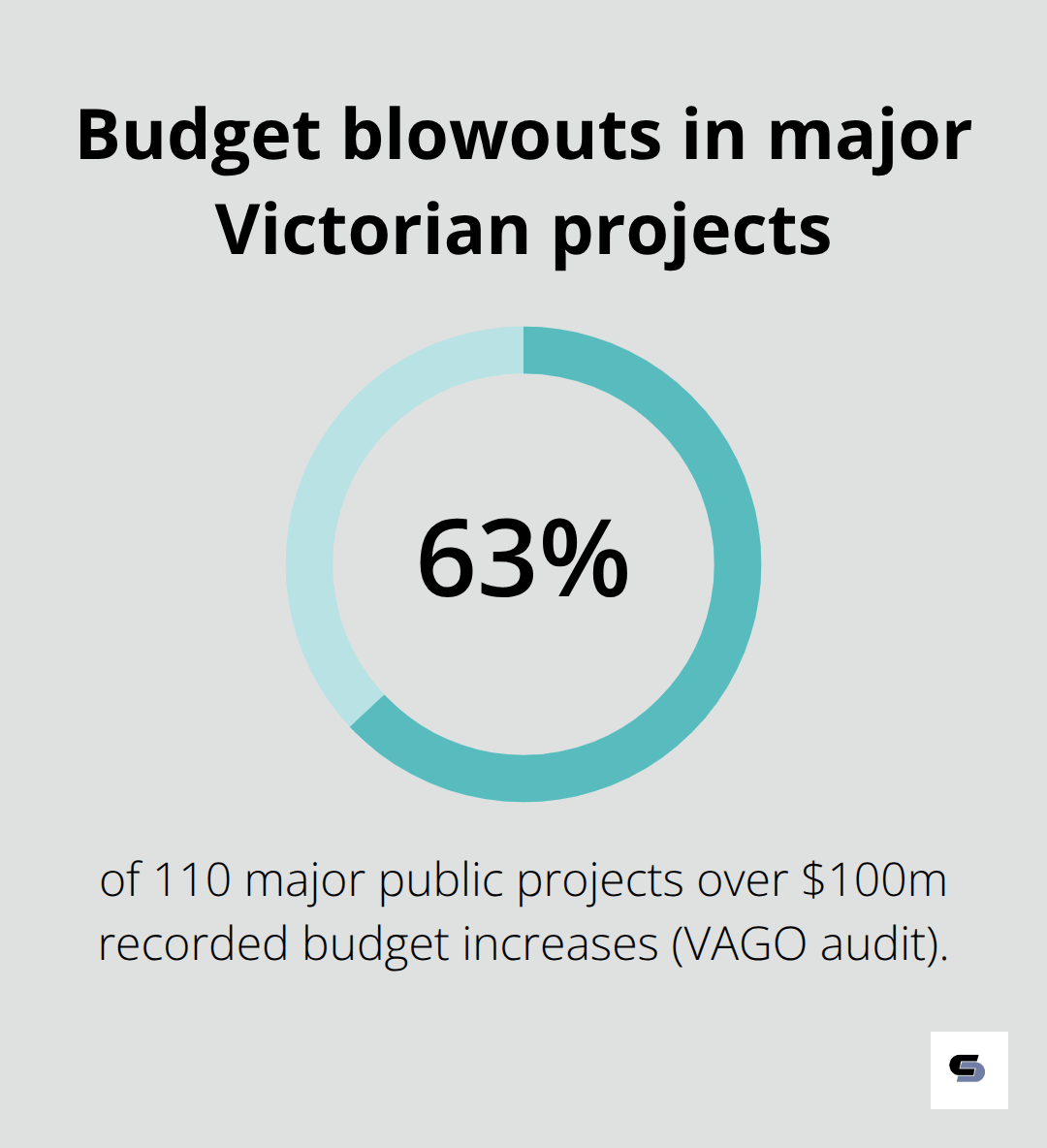
This matters enormously when a structural concern emerges mid-project or material costs shift unexpectedly. A local builder can pivot immediately. A franchise must wait for approval from corporate. The Victorian Auditor-General’s Office examined 110 major public projects worth over $100 million and found that 62.7% experienced budget increases totalling $5.95 billion against only $1.04 billion in decreases. Scope changes drove much of this variance.
Speed Matters When Councils Get Involved
What separates local builders from franchises is responsiveness. When a council planning officer flags a heritage compliance issue specific to your Fitzroy terrace or a soil report reveals unexpected conditions on your Darebin block, local builders have the authority to negotiate solutions immediately rather than escalate requests through corporate approval chains that can delay decisions by weeks.
Local builders maintain relationships with council building departments and heritage officers, which accelerates approvals and prevents costly rework. Franchise operations cycle staff frequently, meaning institutional knowledge about council preferences and neighbourhood restrictions disappears. A local builder understands which Melbourne councils scrutinise double storey extensions more closely or which suburbs have strict heritage overlays requiring specialist detailing. That knowledge, accumulated over decades, prevents expensive design revisions and permit rejections.
Reputation Lives in Your Neighbourhood
Your extension’s quality ultimately reflects your builder’s standing in your community. A franchise can relocate its operations or rebrand. A local builder whose name appears on extensions throughout your neighbourhood cannot hide from poor work. This accountability shapes daily decisions. When a builder knows they’ll encounter their former clients at the supermarket or their child’s school, corners don’t get cut.
Your extension succeeds because your builder has navigated similar constraints in your exact area before. The next section explores how this local expertise translates into cost transparency and the flexibility to manage your project without hidden corporate markups eating into your budget.
How Local Builders Navigate Melbourne’s Planning Complexity
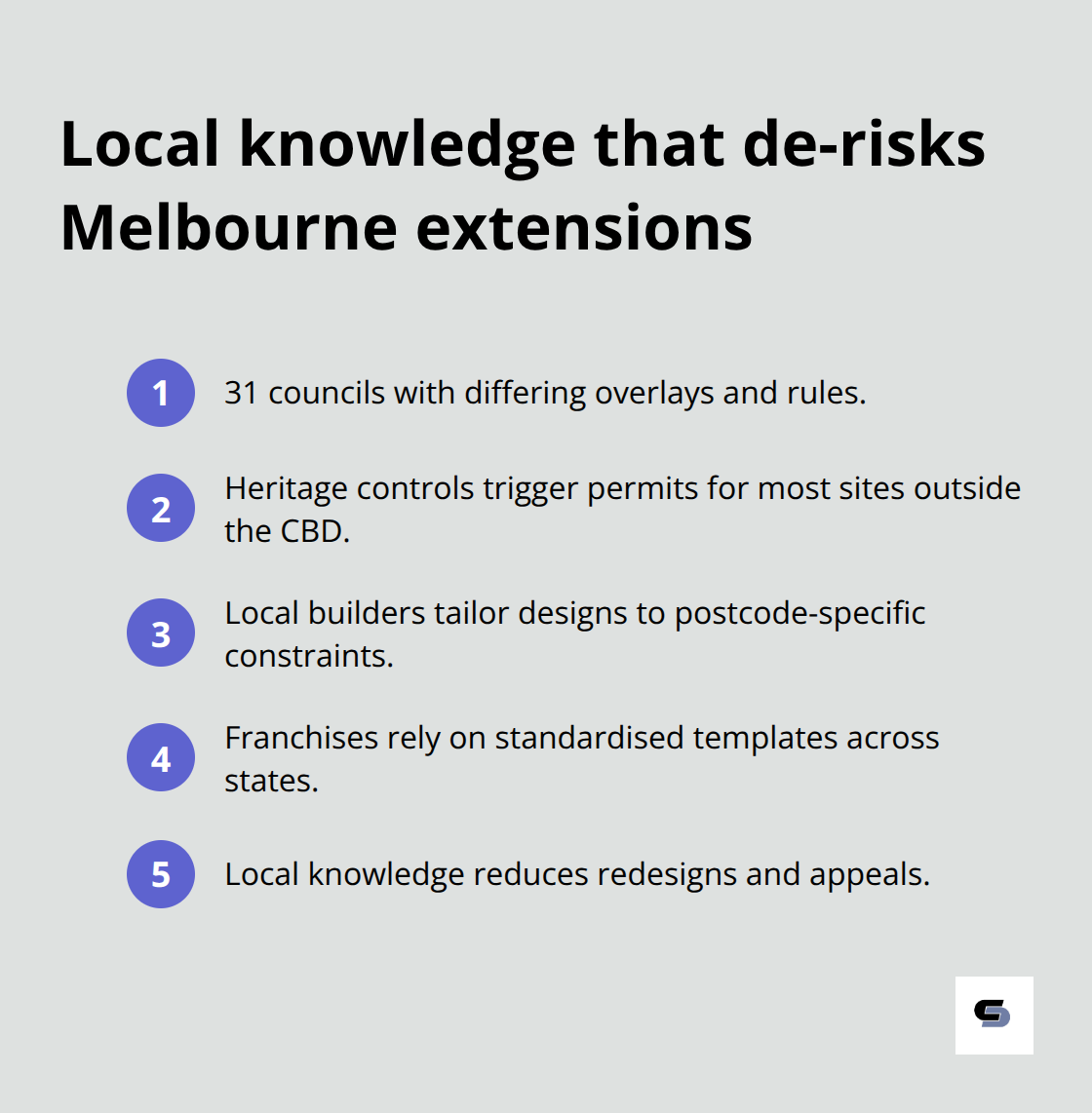
Melbourne’s planning system fragments across 31 councils, each with distinct heritage overlays, neighbourhood character statements, and building height restrictions that shift postcode by postcode. Outside the CBD, most sites sit under heritage controls, meaning a planning permit applies to all buildings and works according to the Melbourne Planning Scheme. A local builder views this fragmentation not as bureaucratic friction but as the foundation of neighbourhood character worth preserving. Franchise operations rely on standardised extension templates applied across multiple states, none of which account for the specific planning constraints that define your suburb.
Why Local Knowledge Prevents Costly Delays
A local builder has spent decades learning exactly which councils scrutinise double storey extensions more closely, which heritage officers prioritise materiality versus form, and which neighbourhoods demand particular setback treatments or roof pitches that preserve streetscape character. This knowledge translates into tangible project advantages. When the Victorian Building Authority or a local council building department flags a compliance concern, a builder with established relationships resolves it through direct conversation rather than formal appeals that consume time and money. A heritage extension in Fitzroy requires different detailing strategies than one in Hawthorn, and a builder who has completed extensions in both suburbs knows exactly how the heritage overlay operates in each location.
Navigating Site-Specific Challenges
Local builders have navigated soil reports revealing unexpected conditions on sloping blocks in Darebin, managed council concerns about overlooking in Abbotsford, and coordinated with building departments across Melbourne’s varied approval processes. Franchise builders cycle staff frequently, meaning that institutional knowledge disappears and each project starts from scratch, forcing clients to absorb the cost of rediscovering what local builders already know. When unexpected site conditions emerge or a council officer raises a neighbourhood-specific concern mid-project, a local builder with established credibility negotiates solutions immediately rather than waiting for corporate approval chains or pulling from a generic playbook.
Building Relationships That Accelerate Approvals
Local builders maintain relationships with council building departments and heritage officers, which accelerates approvals and prevents costly rework. These connections exist because the same builder has worked consistently across the same area for years, delivering projects that satisfy local planning requirements. A builder draws on relationships built through consistent delivery across the specific area where your extension sits, which means faster approvals, fewer design revisions, and extensions that genuinely fit their neighbourhood rather than feeling imposed upon it. This local credibility becomes especially valuable when unexpected site conditions or council concerns require immediate negotiation.
The cost implications of this local expertise extend far beyond permit approvals. When a builder operates without the overhead of corporate markups and head office fees, those savings flow directly to your project budget-and that’s where the real financial advantage of choosing locally emerges.
Where Your Extension Budget Actually Goes
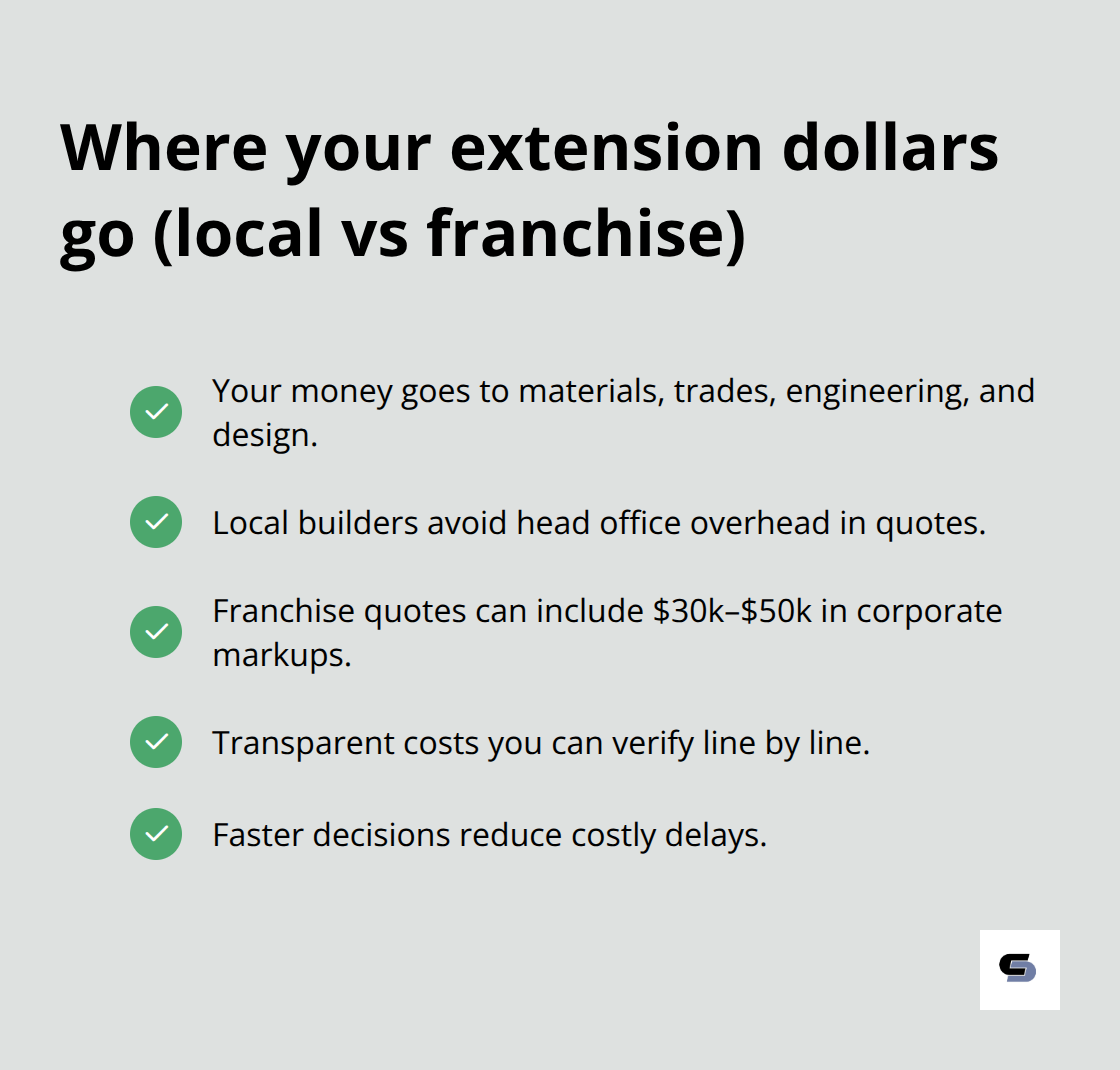
When you engage a franchise operation for your Melbourne extension, corporate overhead becomes your problem. Head office costs, regional management salaries, marketing spend across multiple states, and standardised administrative systems get absorbed into your quote as markup layers that have nothing to do with your actual build. Local builders operate without these structural expenses. Your budget funds materials, skilled trades, engineering, and design-not distant administrative overhead. This transparency matters enormously when comparing quotes. A franchise quote of $450,000 might include $30,000 to $50,000 in corporate markups that never touch your site.
Corporate Markups vs. Direct Costs
Franchise operations maintain hierarchies that local builders simply don’t carry. A franchise absorbs state-wide marketing campaigns, regional management structures, and standardised administrative systems into every project quote. These costs accumulate invisibly. A local builder passes savings directly to your project because overhead stays minimal. When you compare two quotes for a double storey extension in Darebin, the franchise quote includes layers of corporate expense that a local operation avoids entirely. That $30,000 to $50,000 difference funds additional quality or genuine cost savings you can verify line by line.
Negotiating Changes Without Approval Chains
Mid-project budget adjustments reveal the real difference between local and franchise builders. When unexpected site conditions emerge on your sloping block in Darebin or a council heritage officer requests materiality changes to your Fitzroy extension, a franchise operation escalates the change request through approval chains that consume weeks. You pay for the delay while waiting for corporate sign-off on a $15,000 material substitution. A local builder negotiates directly with you and your suppliers, implementing solutions within days rather than months. When soil conditions require deeper foundations or heritage constraints demand specific brickwork details, immediate negotiation prevents the compounding costs that plague large-scale projects. Materials and timelines shift constantly in construction, and a builder with direct authority over decisions keeps your project moving rather than stalling it in approval queues.
Supply Chain Advantages Through Local Relationships
Local builders negotiate directly with material suppliers because they’ve worked with the same concrete contractors, bricklayers, and glazing specialists for years. That continuity creates genuine cost advantages. Suppliers offer better pricing to consistent clients, and local builders access materials faster because they’ve established supply chains specific to Melbourne’s building requirements. A franchise sources through corporate-approved suppliers across multiple states, eliminating the negotiating leverage and speed that local relationships provide. When your extension needs 200 bricks matching your existing heritage facade or specific Australian-standard windows for council compliance, a local builder sources these through established contacts while a franchise works through standardised procurement systems designed for volume rather than precision.
Final Thoughts
Melbourne families planning extensions face a straightforward choice. Local extension builders operate with direct accountability, established council relationships, and transparent cost structures that franchises cannot replicate. When unexpected site conditions emerge on your sloping block or a heritage officer requests materiality changes mid-project, a local builder negotiates solutions immediately rather than escalating requests through corporate approval chains. That responsiveness protects your timeline and budget in ways that matter enormously over the course of a construction project.
The long-term value of choosing established local expertise extends beyond your individual extension. A builder whose reputation lives in your neighbourhood maintains standards because they encounter their former clients regularly. They navigate the specific planning constraints that define your suburb, understand which councils scrutinise double storey additions more closely, and know exactly how heritage overlays operate in your postcode (accumulated knowledge that prevents costly design revisions and permit rejections). That foundation prevents the problems that plague projects managed by builders cycling through multiple states.
Your extension succeeds when your builder operates as a genuine partner rather than a corporate service provider. Contact Cameron Construction to discuss your extension plans with builders who understand Melbourne and stake their reputation on your project’s success.
![Second Storey Additions For Growing Families [Guide]](https://www.cameronconstruction.com.au/wp-content/uploads/emplibot/second-storey-additions-hero-1772259809-150x150.webp)