Sloping Block Extensions Melbourne: Design That Adapts to Challenging Terrain
Sloping blocks intimidate most Melbourne homeowners, but we at Cameron Construction see them as opportunities. The terrain that seems problematic actually offers design advantages when handled correctly.
This guide covers everything from foundation strategies to council approvals, so you understand what’s involved in building on challenging ground.
Why Sloping Blocks Create Better Extensions
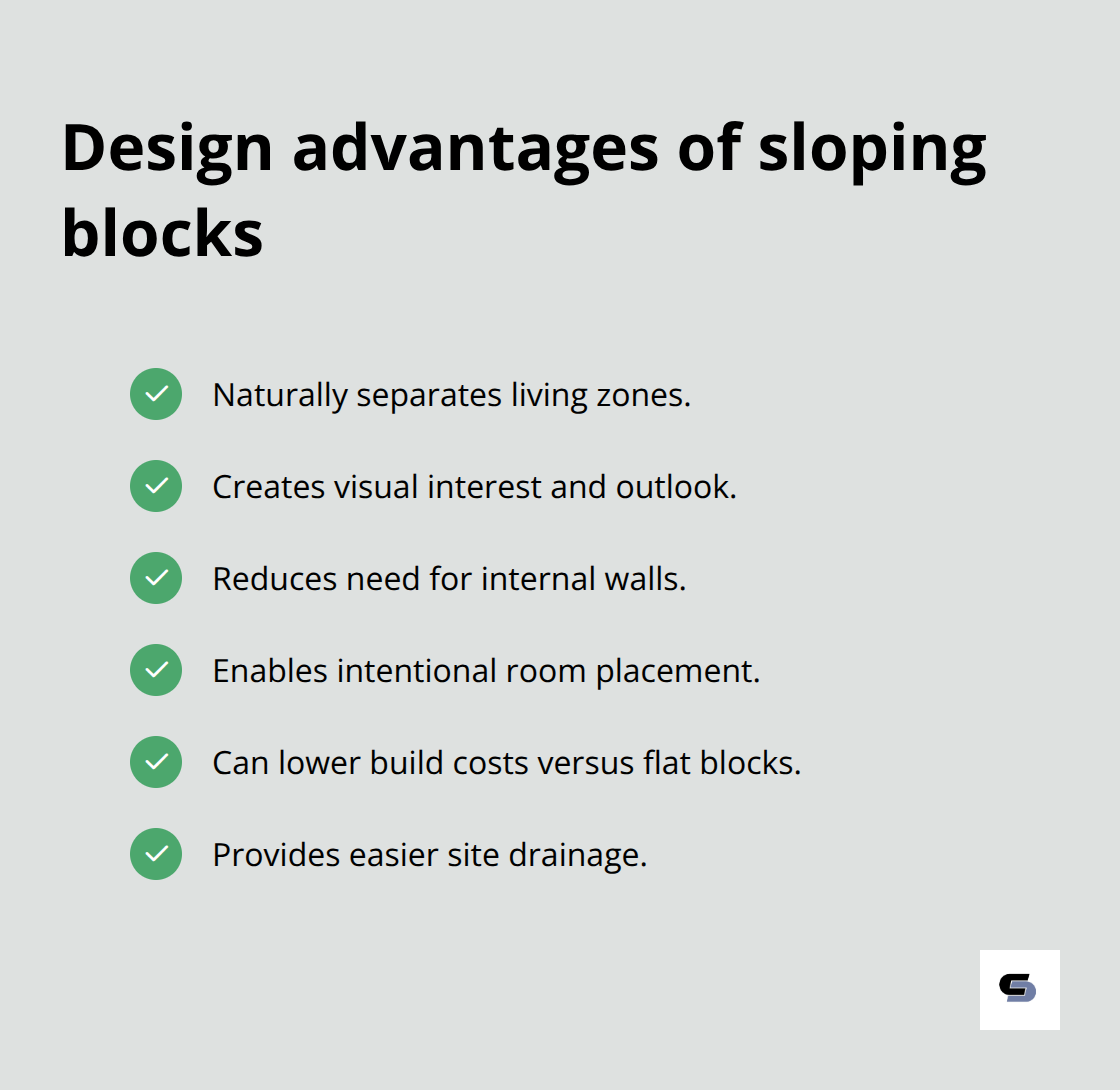
Sloping blocks intimidate most Melbourne homeowners, but the terrain that seems problematic actually offers genuine design advantages when handled correctly. A flat block lets builders stack rooms without thought; a slope demands intentional placement and spatial planning. This constraint drives extensions that work harder, function better, and often cost less to build than equivalent additions on flat land. The terrain naturally separates living zones, creates visual interest, and reduces the need for expensive internal walls to define spaces. A 15-degree slope across a standard 600-square-metre block creates roughly 1.5 metres of level difference-enough to establish distinct zones without construction intervention.
Split-level design cuts construction costs
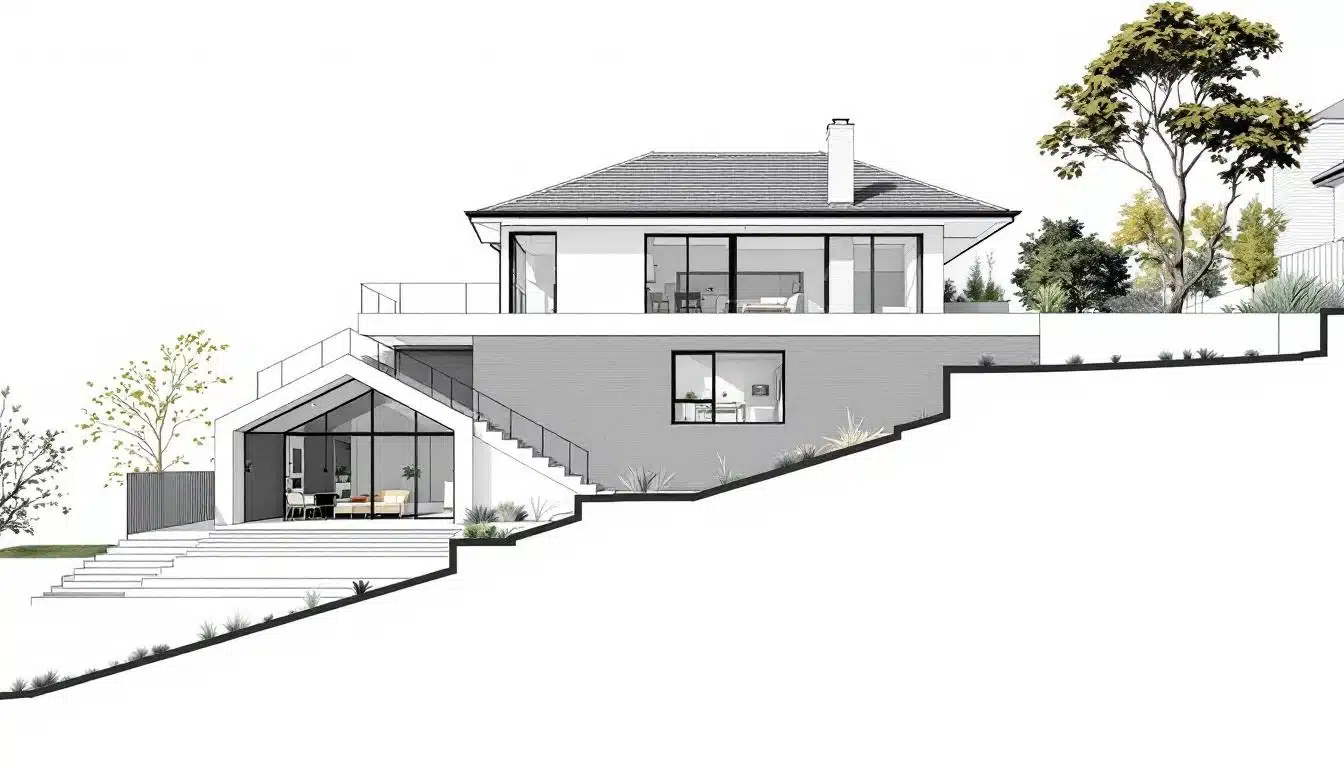
Split-level extensions on slopes typically cost 10 to 15 percent less than equivalent flat-block additions because the terrain does half the work. Rather than building a traditional two-storey addition, a well-designed split-level uses the natural slope to create multiple functional levels from a single structure. Your foundation footings sit at different depths on the high and low sides (this is standard practice, not a problem), and each level connects naturally to the surrounding ground. A stepped foundation approach means you avoid expensive excavation, extensive fill, or unnecessary retaining walls. The Ordinary Miracle project, a high-performance home extension on a hillside site, demonstrates this principle: the design started on the high side and used pier-and-wall foundations to maintain single-level accessibility while working with the slope rather than against it. This approach reduced site disturbance, minimised earthworks costs, and delivered a home that achieved an 8.6-star NatHERS rating. Drainage also improves naturally on slopes because water moves downhill without ponding-you need less complex stormwater infrastructure than a flat block demands.
Orientation and views transform extension value
Sloping blocks typically offer better northern exposure and views, which Melbourne extension buyers value highly. A north-facing living area on a slope receives consistent winter sun without summer overheating if designed correctly. The Ordinary Miracle extension achieved substantial energy savings-approximately $473 annually on energy bills-through thoughtful orientation combined with proper shading and insulation. Sustainability Victoria’s 7-Star Upgrade Analysis shows that orientation and shading alone can deliver up to 1.2-star NatHERS improvements, making it one of the easiest performance wins available. Your extension’s position on the slope determines how much natural light and solar heat it captures. A ground-floor extension positioned on the north side of the existing dwelling gains maximum winter sun, while upper-level spaces can be set back to avoid summer heat. This natural hierarchy means you design fewer shading devices and achieve comfort without relying entirely on mechanical cooling.
How terrain creates market appeal
Buyers perceive slope-sited extensions as more valuable because they typically offer visual separation from neighbours and stronger connection to landscape views-factors that flat-block extensions struggle to deliver. The natural topography of suburbs like Eltham, Kallista, and Olinda means sloping extensions command attention in the market. Terrain that forces better design decisions also produces homes that feel more considered and intentional. These advantages translate directly into extension value, making the initial design complexity worthwhile. Understanding how your slope works-rather than fighting it-sets the foundation for the structural and planning decisions that follow.
Foundations That Work With Your Slope
Stepped foundations adapt to terrain
Stepped foundations form the structural backbone of sloping block extensions, and they work far simpler than most Melbourne homeowners assume. Rather than levelling your entire site (expensive and destructive), you place foundation footings at different depths on the high and low sides of your block. Planning Practice Note 27 governs these setups in Victoria, and the rules are straightforward: your foundation depth depends on where you sit on the slope, not on arbitrary design choices. A competent structural engineer calculates footing depths based on soil conditions, slope angle, and the weight your extension carries. On a 15-degree slope, your high-side footings might sit 400 millimetres deep while low-side footings go 1.2 metres down. This isn’t complicated-it’s standard engineering. Foundation systems that work on slopes prove that stepped approaches preserve usability while respecting terrain.
Split-level layouts reduce earthworks costs
Split-level extensions follow naturally from stepped foundations: each level of your extension sits where the ground naturally supports it, eliminating the need for expensive fill, excessive retaining walls, or complex internal ramps. Your extension’s floor levels step down as the site slopes, creating distinct zones for living, sleeping, or utility spaces. This approach cuts construction costs by 10 to 15 percent compared to flat-block additions because earthworks remain minimal and foundations work with gravity rather than against it. The terrain does half the structural work, so your builder avoids the excavation, fill, and reinforcement that flat sites demand.
Retaining walls serve specific purposes
Retaining walls become necessary only when you need to create flat usable space that the slope won’t naturally provide. Most Melbourne homeowners over-build retaining walls, treating slopes as problems to be erased rather than features to accommodate. A 1.2-metre retaining wall costs significantly more than accepting a gentle slope for a pathway or garden terrace. Victoria’s planning rules limit wall height and length based on boundary proximity and slope angle, so check Planning Practice Note 27 before committing to large structures. Walls on boundaries cannot exceed 10 metres plus 25 percent of remaining boundary length, and if your wall measures less than 2 metres effective height due to slope or cut-and-fill, it can run the full boundary.
Drainage becomes critical with retaining walls: water must move away from the wall base, not accumulate behind it. Geotechnical assessment identifies soil type, permeability, and slope stability before you design any retaining structure. If your soil is clay-based with poor drainage, a 1.5-metre wall requires subsurface drainage that adds 15 to 25 percent to construction cost. Stepped footings and alternative foundation approaches often cost less and look better than a single high wall. Two 600-millimetre walls with planted terraces between them typically cost 20 percent less than one 1.2-metre wall and create usable garden space.
Basements and undercrofts maximise slope advantages
Basement and undercroft spaces work well on slopes because the high side of your block naturally creates headroom below the extension. A ground-level entry on the high side becomes a basement entry on the low side, giving you storage, utility, or secondary living space without additional excavation. Undercrofts (partially enclosed areas beneath elevated structures) suit sloping sites because they require minimal fill and provide weather protection without the cost of full basements. Building codes require minimum headroom of 2.1 metres for habitable spaces, adequate drainage, and proper ventilation. Undercrofts work best for carports, storage, or plant rooms; living spaces need full basement treatment with waterproofing and services.
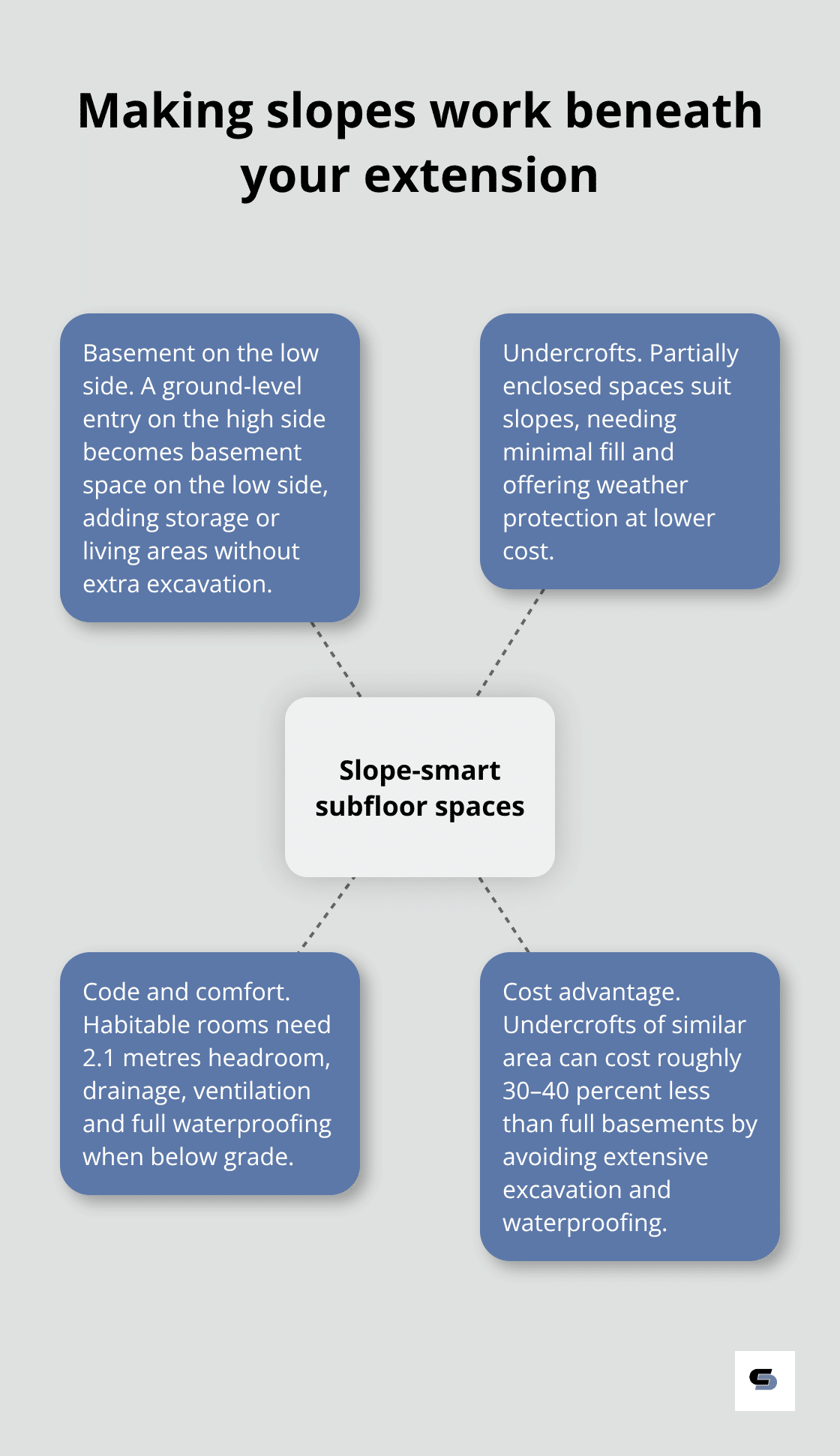
A 40-square-metre undercroft costs roughly 30 to 40 percent less than an equivalent basement because it avoids extensive excavation and waterproofing complexity.
Geotechnical reports determine whether your soil can support basement construction without excessive pumping or retaining costs. Expansive clay soils common in outer Melbourne suburbs like Gembrook and Narre Warren require special basement design and can add 20 to 30 percent to construction budgets. These soil assessments happen early in your project planning, before you commit to foundation design or layout decisions. Your structural engineer uses geotechnical data to specify footing depths, drainage requirements, and any soil stabilisation work your extension needs. This assessment protects your investment and prevents costly surprises during construction.
Planning Sloping Block Extensions
Melbourne councils apply strict rules to sloping block extensions, and most of these rules exist in Planning Practice Note 27, which governs residential development on slopes across Victoria. Your extension’s height, setbacks, and wall placement depend entirely on your site’s slope angle, measured from natural ground level. If your block slopes at least 2.5 degrees (roughly 350 millimetres of rise over 8 metres), you qualify for a 10-metre building height limit measured from natural ground level, not from the lowest adjoining property. Flat blocks max out at 9 metres. This distinction matters: a sloping site genuinely allows taller extensions than flat land, which changes your design possibilities significantly.
Height and Setback Requirements
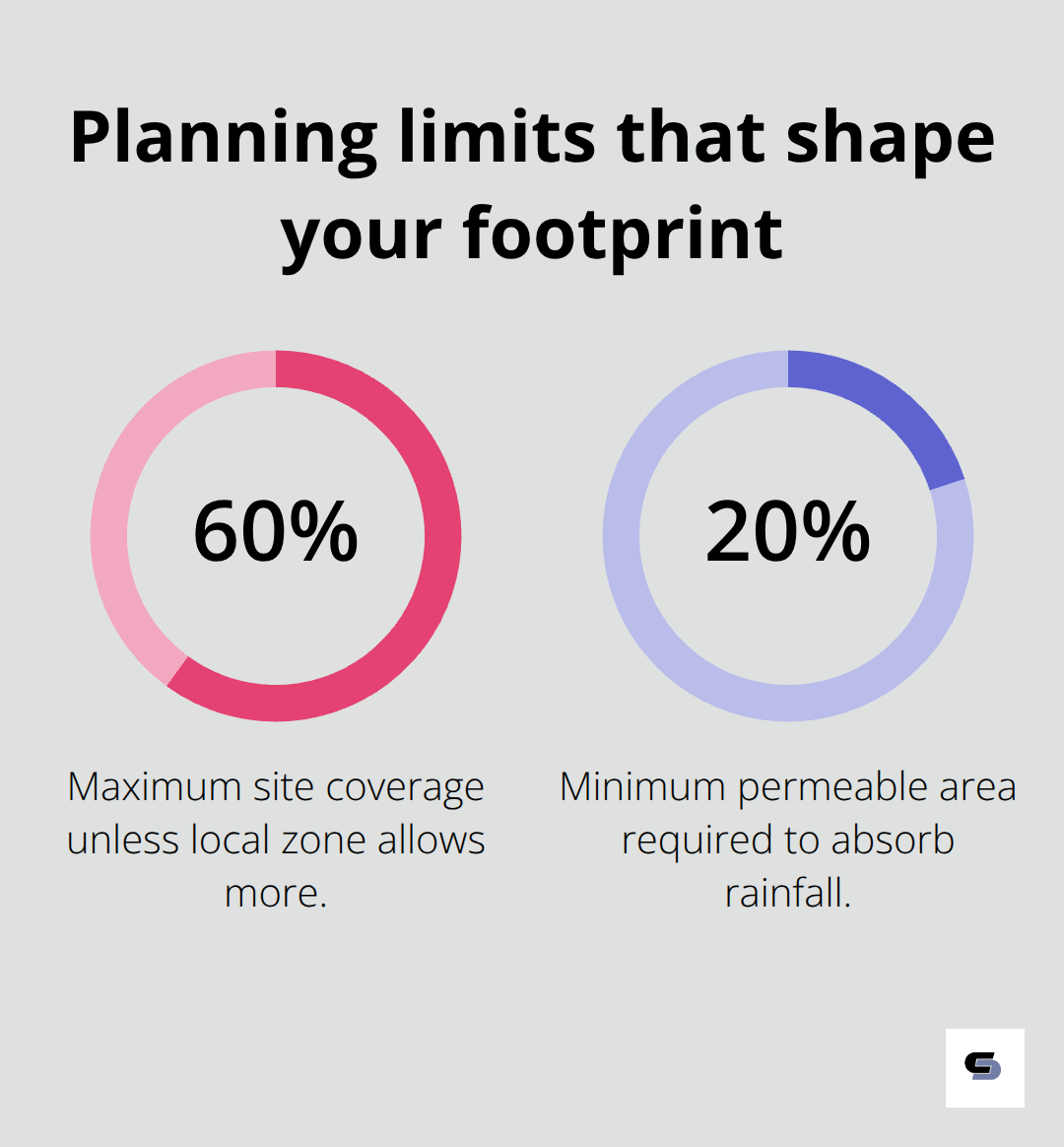
Front setbacks vary by street context. Streets in Transport Zone 2 require 6-metre setbacks, while other streets need 4 metres unless adjoining buildings exist, in which case you match the average of those buildings’ setbacks. Side and rear setbacks increase with wall height at 1 metre plus 0.3 metres per metre of height above 3.6 metres up to 6.9 metres, then 1 metre per metre above that threshold. Walls on boundaries cannot exceed 10 metres plus 25 percent of remaining boundary length per boundary, though walls under 2 metres effective height due to slope can run the full length. Site coverage caps at 60 percent unless your local zone allows more, and at least 20 percent of your site must remain permeable to manage rainwater runoff. These constraints shape your extension’s footprint before you even start structural design, so understanding them early prevents costly redesigns later.
Soil Assessment and Foundation Planning
Geotechnical assessment determines whether your soil can support the extension you want to build, and this assessment must happen before detailed design work starts. Soil type, slope stability, and drainage capacity directly influence foundation depth, retaining wall design, and overall construction cost. Clay-heavy soils common in suburbs like Ringwood, Ferntree Gully, and Narre Warren expand when wet and contract when dry, requiring special foundation detailing that adds 15 to 25 percent to costs. Sandy or gravelly soils drain faster but may need deeper footings if the slope is steep. A geotechnical report specifies footing depths, drainage requirements, and any soil stabilisation work your extension requires.
Water Management on Slopes
Drainage and erosion control become critical on slopes because water accelerates downhill and concentrates at the base of retaining walls or building foundations. At least 20 percent site permeability means you cannot pave or seal more than 80 percent of your block; the remaining area must absorb rainfall. Subsurface drainage behind retaining walls prevents hydrostatic pressure that can crack or destabilise structures, and this drainage system costs 15 to 25 percent more than surface drainage alone. Downpipe connections must direct water away from foundations, not toward them, and swales or gentle slopes guide water across your site without erosion. Your structural engineer and geotechnical specialist work together to confirm that your extension design manages water movement safely, protecting both your building and neighbouring properties from slope failure or flooding.
Final Thoughts
Sloping block extensions Melbourne homeowners build demand more planning than flat-site additions, but the payoff justifies the effort. A slope that initially seems problematic transforms into your extension’s greatest asset when you design it properly. You gain natural level separation, better orientation, reduced earthworks costs, and superior drainage without expensive infrastructure. Professional design matters on slopes because mistakes compound quickly-a foundation placed at the wrong depth, a retaining wall built without proper drainage, or setbacks that violate Planning Practice Note 27 can derail your project mid-construction or trigger council rejection.
Geotechnical assessment, structural engineering, and town planning expertise must align from the start. Your designer needs to understand how soil type influences foundation cost, how slope angle determines building height limits, and how water moves across your site. These decisions interconnect, and skipping any step creates expensive problems later. We at Cameron Construction have spent 40 years building extensions across Melbourne’s varied terrain, including countless sloping block projects in suburbs like Eltham, Kallista, and Ferntree Gully.
Your next step is straightforward: engage a builder and designer experienced with sloping sites, commission a geotechnical assessment, and confirm your council’s specific requirements for your suburb. These three actions clarify what your slope allows and what it costs. Contact Cameron Construction to discuss your sloping block extension and understand how professional design transforms challenging terrain into genuine opportunity.