![Second Storey Additions For Growing Families [Guide]](https://www.cameronconstruction.com.au/wp-content/uploads/emplibot/second-storey-additions-hero-1772259809.webp)
Second Storey Additions For Growing Families [Guide]
Growing families need more space, and second storey additions offer the most practical solution for Melbourne homes. We at Cameron Construction have guided hundreds of homeowners through this process, and we know the decisions ahead can feel overwhelming.
This guide walks you through every stage-from assessing your home’s structure to managing construction. You’ll learn what council approvals you need, how to work with designers, and what to expect on site.
Planning Your Second Storey Addition
Assess Your Foundation Before You Design
Your home’s ability to support a second storey depends entirely on what lies beneath. Most Melbourne homes built before 1980 were designed for single-storey living, which means adding weight above requires serious engineering assessment. A soil report is non-negotiable-your builder must obtain foundation data and soil conditions to design footings that won’t fail. This costs between $800 and $1,500, but skipping it means pricing the extension blind and risking catastrophic settlement issues later.
Your building surveyor will use this data to confirm whether your existing footings can handle the load or if underpinning is necessary. Underpinning costs $15,000 to $40,000 depending on soil type and depth, so knowing this upfront prevents nasty surprises mid-construction. Get the soil report done first, not after you’ve fallen in love with design plans.
Match Your Layout to How Your Family Actually Lives
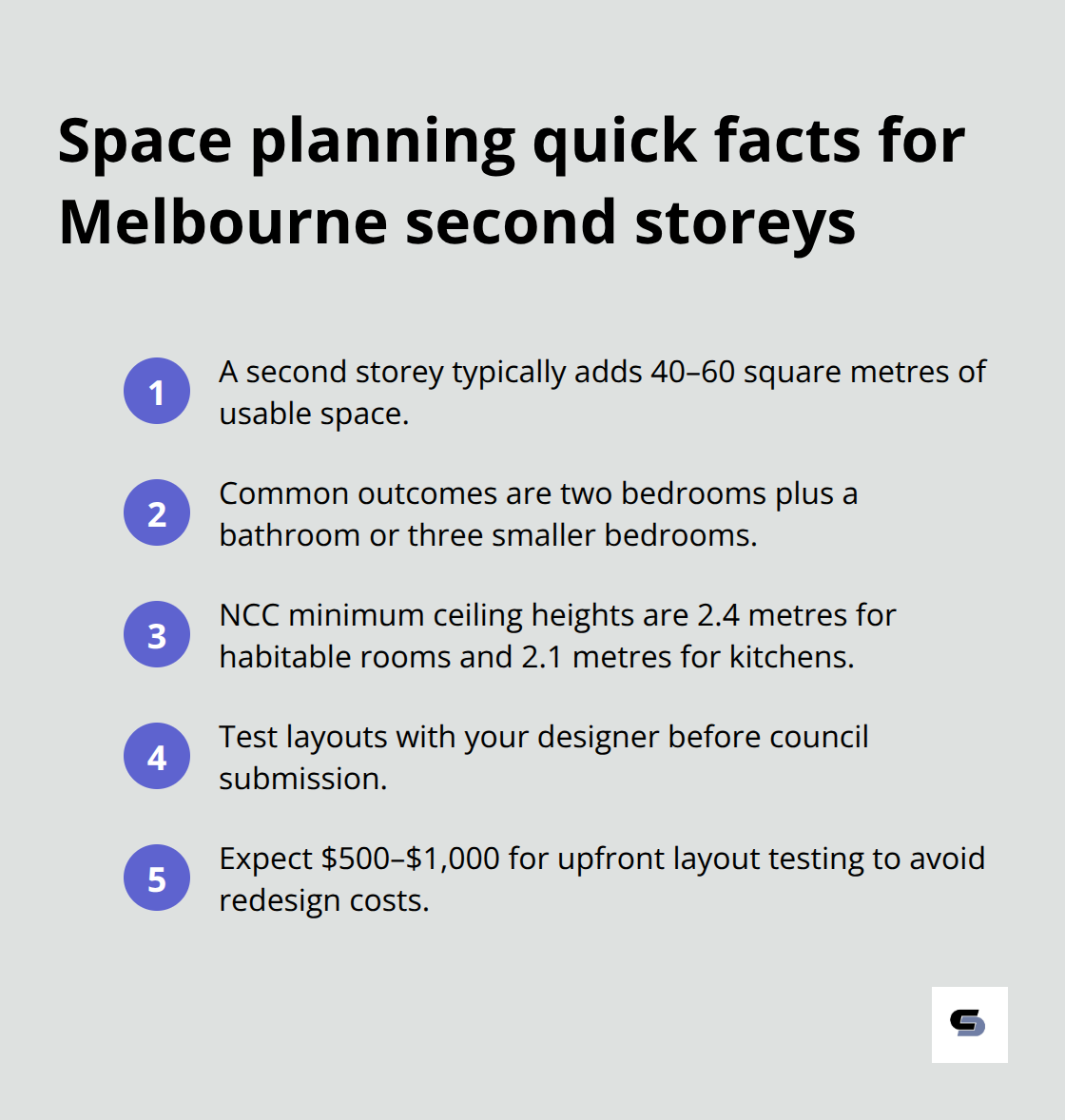
Growing families don’t need more bedrooms equally-they need flexibility. A second storey typically adds 40 to 60 square metres of usable floor space, which translates to two bedrooms plus a bathroom or three smaller bedrooms. Consider how your family will actually live in the space. Will teenagers need separate rooms? Does a home office matter more than extra bedrooms? Do you need a retreat space away from younger children?
The National Construction Code requires minimum ceiling heights of 2.4 metres in habitable rooms and 2.1 metres in kitchens, which affects how much usable space you genuinely gain on sloping roofs. Many families discover that three smaller rooms feel cramped compared to two generous bedrooms with storage. Work with your building designer to test layouts before council submission-this costs $500 to $1,000 but prevents costly redesigns after planning approval.
Calculate Your True Project Cost and Timeline
Second storey additions in Melbourne currently cost between $3,500 and $5,500 per square metre, depending on finishes and site complexity. A 50-square-metre addition therefore sits between $175,000 and $275,000. Add soil reports, engineering, permits, and design fees-you’re looking at $185,000 to $290,000 before construction starts.
The entire process from concept to occupancy typically takes 12 to 18 months. Planning approval alone takes 8 to 12 weeks in most Melbourne councils, longer if your property has heritage overlays or falls within character zones. Building permits then require another 2 to 4 weeks. Construction itself runs 4 to 6 months for a standard second storey, longer if your home needs structural work.
Budget conservatively and add 15 to 20 per cent contingency for unforeseen structural issues-these are common in older homes and non-negotiable once discovered. Many homeowners underestimate the approval phase and feel shocked when they can’t break ground for nearly a year. Understanding these timelines now means you’ll work with realistic expectations as you move into design and approvals.
The Design and Approval Process
Your Designer Must Understand Council Rules Before Drawing
Your designer and council approvals move in parallel, not sequence-most homeowners get this wrong. A designer familiar with your specific council (whether Bayside, Boroondara, or Whitehorse) knows which overlays trigger extra scrutiny, which setback rules apply, and whether VicSmart fast-track approval is realistic for your site. This knowledge saves weeks and thousands in redesigns.
When interviewing designers, ask specifically about their approval track record with your council and request examples of similar projects they’ve navigated through planning. A good designer costs $2,000 to $5,000 for concept and schematic design before you commit to full documentation-this investment prevents the catastrophe of falling in love with plans that council will reject.
Engage Your Structural Engineer Before Planning Submission
Your designer must also engage a structural engineer early, not after planning approval. Foundation capacity, roof loading, and wall bracing affect both what you can build and what it costs. The engineer’s report becomes part of your planning submission and building permit application, so having this completed upfront means no surprises when council or the building surveyor reviews your plans.
Structural compliance for a second storey is non-negotiable. Your engineer must confirm that existing foundations, walls, and roof structures can handle additional load. Any underpinning or bracing becomes a line item in your contract. Many older Melbourne homes need reinforced concrete footings or steel bracing that adds $15,000 to $40,000, so the engineer’s assessment directly impacts your final budget.
Navigate Planning Approval Timelines and Requirements
Planning approval timelines vary wildly depending on overlays and zoning. A straightforward second storey on a General Residential Zone property typically takes 8 to 10 weeks, but add a heritage overlay or character precinct and you’re looking at 12 to 16 weeks minimum. Contact your local council early to get exact planning fees for extensions, as these depend on project specifics.
Many Melbourne councils now encourage pre-lodgement meetings with planning officers-these cost nothing and take 30 minutes. Officers will tell you exactly what documentation you need and whether conditions are likely. Use VicPlan to confirm your property’s zoning and overlays before your designer starts work; this five-minute step prevents months of wasted effort on designs that won’t comply.
Obtain Your Building Permit and Schedule Inspections
Once planning approval is granted, your building permit application goes to a registered building surveyor, who verifies compliance with the National Construction Code 2022 and relevant building regulations. The surveyor needs at least three copies of detailed drawings, specifications, allotment plans, and the completed application form. Building permit fees are paid as a levy based on construction cost and go directly to the Victorian Building Authority before a permit number is issued.
The entire building permit process typically takes 2 to 4 weeks, though councils can request further information that delays this. Mandatory inspections occur at key stages: foundation, frame, lock-up, and completion. Plan these into your timeline and budget for the building surveyor’s site visits. Once your permits are locked in, selecting the right builder becomes your next critical decision-one that determines whether your addition stays on schedule and within budget.
Choosing Your Builder and Managing Construction
Select a Builder with Proven Second Storey Experience
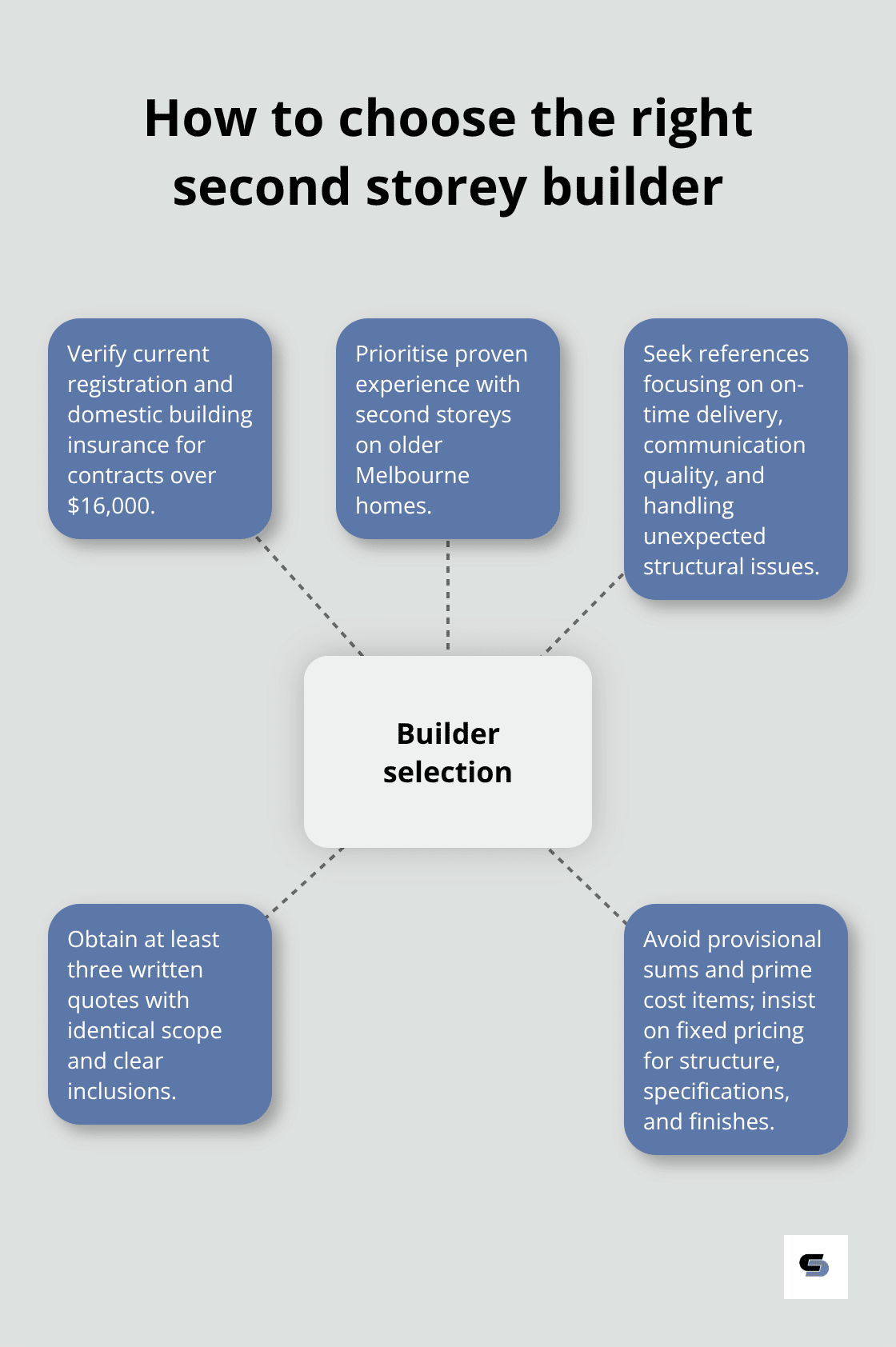
Your builder transforms approvals into reality, and this choice determines whether your addition finishes on time and within budget. The builder must hold current registration with the Building Practitioners Board and provide proof of domestic building insurance (mandatory for contracts over $16,000). Ask prospective builders directly for their registration number and verify it on the Building Practitioners Board website before proceeding.
Experience with second storey work on older Melbourne homes matters far more than glossy portfolios. Check references from previous clients about on-time delivery, communication quality, and how they handled unexpected structural issues. Request at least three written quotes for identical scope and compare what each includes: design refinement, permit fees, structural work, and allowances. Never accept vague quotes with provisional sums or prime cost items that lock in uncertainty; every structural element, material specification, and finish must appear in the contract with fixed pricing.
Structure Payments to Match Completed Work
Your contract must specify staged payments aligned to completed work, not calendar dates. Pay for foundation and underpinning only when the building surveyor confirms it meets engineering requirements. Release frame payment when lock-up is achieved, fixings payment when inspections pass, and final payment only when the Occupancy Permit is issued. This approach protects your money and keeps your builder accountable.
Any variations to scope must be requested in writing and signed before work proceeds; verbal agreements about extra work guarantee disputes. Control your costs by pre-selecting all fixtures, fittings, and finishes before construction starts and ensuring these appear in the contract rather than as future decisions. Your builder should provide a detailed project schedule showing critical inspection dates, permit milestones, and subcontractor sequencing before work begins.
Attend Weekly Site Meetings and Document Progress
During construction, attend weekly site meetings and document progress against the agreed schedule. Delays compound quickly and become expensive to recover. Your building surveyor’s mandatory inspections occur at foundation, frame, lock-up, and completion stages, so these dates control your entire timeline. Missing an inspection date means waiting for the next available slot, typically one to two weeks later.
Establish a communication protocol with your builder for unexpected issues. Structural problems discovered mid-build require immediate engineer assessment and written variation orders, not guesswork solutions. Once lock-up is achieved, interior work proceeds faster and disruption drops significantly, so pushing hard on structural completion protects your schedule and sanity.
Plan Site Logistics to Minimise Disruption
Minimising disruption requires planning site logistics with your builder upfront. Agree on parking arrangements for tradies, material delivery windows, waste management, and hours of work before day one. Most Melbourne councils restrict construction hours to 7 AM to 6 PM weekdays and 9 AM to 1 PM Saturdays, with no Sunday work. Your builder must schedule noisier tasks (concrete cutting, roof work) during these permitted windows to maintain good relations with neighbours and comply with local regulations.
Final Thoughts
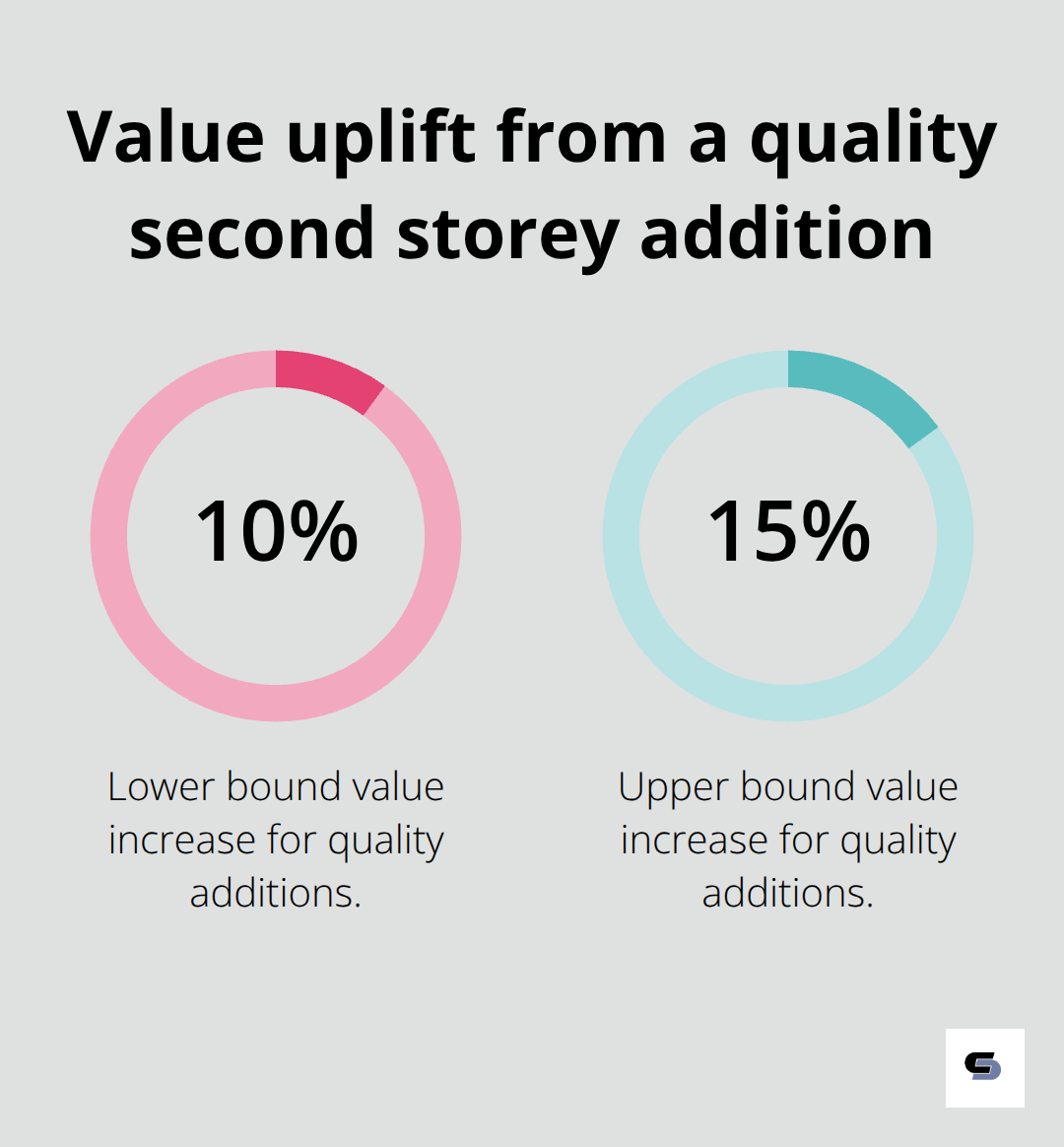
Second storey additions solve space constraints without forcing your family to relocate and abandon your established community. The process demands planning across structural assessment, approvals, and builder selection, but the payoff justifies every step. A quality second storey addition costs $175,000 to $290,000 fully delivered and typically adds 10 to 15 per cent to your home’s value, meaning you recover most of your investment while gaining the space your growing family needs now.
The timeline of 12 to 18 months from concept to occupancy feels manageable once you understand that selling and buying a new property takes longer and costs far more in agent fees and stamp duty. Planning approval takes 8 to 12 weeks, building permits another 2 to 4 weeks, and construction itself runs 4 to 6 months-this predictability lets you plan your family’s life around the project rather than face unexpected delays. Contact a building designer familiar with your specific council to discuss your site and family needs, request a soil report immediately, and verify your property’s zoning using VicPlan.
We at Cameron Construction handle second storey additions from concept to completion, including design, engineering, permits, and BCA compliance across Melbourne’s councils. If you’re ready to explore whether a second storey works for your home and family, contact us for a no-obligation discussion about your project.